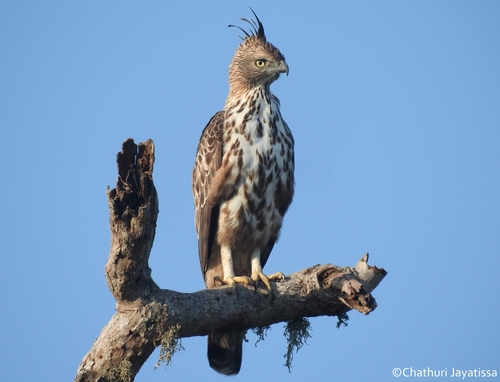
Changeable Hawk-Eagle
Nisaetus cirrhatus
The ultimate forest chameleon, the Changeable Hawk-Eagle is a master of the 'sit-and-wait' ambush. With its striking yellow eyes and adaptable nature, it is one of Asia's most successful and widespread birds of prey.
Quick Identification
Size
Length 51–82 cm (20–32 in); wingspan 100–160 cm (39–63 in); weight 1.3–1.9 kg (2.9–4.2 lbs)
Colors
Highly polymorphic; pale morphs have dark brown upperparts and white underparts with dark streaks, while dark morphs are almost entirely chocolate brown. Both feature bright yellow eyes.
Key Features
- Distinctive crest of feathers on the crown (subspecies dependent)
- Feathered legs (tarsus) all the way to the toes
- Broad, rounded wings and a long, barred tail
- Sharp, hooked black beak with a yellow cere
When You’ll See Them
Geographic range
Where Does the Changeable Hawk-Eagle Live?
Native to the tropical and subtropical regions of South and Southeast Asia, the Changeable Hawk-Eagle enjoys a massive distribution. Its core range spans from the Indian subcontinent and Sri Lanka through the Indochinese peninsula to the islands of Indonesia and the Philippines. Because it is so adaptable to different wooded environments, it is often the most frequently sighted large eagle in countries like Thailand, Malaysia, and India.
Basemap © OpenStreetMap contributors
Behavior
While generally solitary or seen in pairs, these eagles are territorial and will vocalize with high-pitched, screaming whistles to defend their space. Despite being forest birds, they are remarkably adaptable and have learned to coexist with human development, often frequenting the edges of villages and suburban areas where prey is abundant. They are resident birds, meaning they do not migrate, and will often use the same nesting site year after year.
EverydayEarth exclusive
Camera Tips
To capture high-quality images of a Changeable Hawk-Eagle on a trail camera, focus on 'sentinel trees'—tall, often dead or partially bare trees that stand above the rest of the canopy or sit at the edge of a clearing. These are preferred hunting perches. Mount your camera at a significant height, ideally 10-15 feet up, using a tree-climbing kit or a long ladder. Angle the lens slightly downward toward a sturdy, horizontal branch that shows signs of use (like droppings or 'whitewash').
Since these birds are triggered by movement, use a camera with a fast trigger speed (0.2 seconds or less). Set your device to 'Hybrid Mode' to capture a high-resolution still followed by a 15-30 second video clip. This allows you to witness their scanning behavior and the impressive moment they take flight. If your backyard features a water source or a large bird bath, this is an excellent secondary location, especially during the dry season when raptors descend to drink and bathe.
Lighting is your biggest challenge in the forest. Position cameras facing North or South to avoid the direct glare of the rising or setting sun, which can wash out the intricate details of the eagle's plumage. Because this species has both pale and dark morphs, ensure your camera's exposure settings are balanced; otherwise, dark morph individuals may appear as featureless silhouettes against a bright sky. If you are monitoring a nest site, maintain a respectful distance of at least 50 meters and use a long-range cellular camera to avoid disturbing the breeding pair.
Similar Species
Species that look similar or are commonly confused with Changeable Hawk-Eagle.
Frequently Asked Questions
Record Changeable Hawk-Eagle at your habitat
Connect a camera to start building your own species record — AI identifies every visitor automatically.