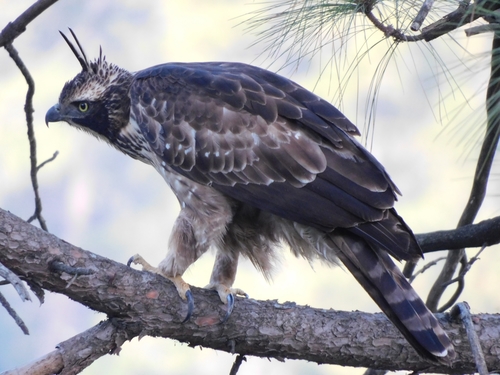
Mountain Hawk-Eagle
Nisaetus nipalensis
The Mountain Hawk-Eagle is a powerful forest ghost, distinguished by its magnificent crest and feathered legs. Ruling the high-altitude canopies of Asia, this secretive raptor is the ultimate prize for backyard observers and wildlife photographers alike.
Quick Identification
Size
Length: 67-86 cm (26-34 in); Wingspan: 130-165 cm (51-65 in); Weight: 2.5-3.5 kg (5.5-7.7 lbs)
Colors
Dark brown upperparts with white-tipped feathers; pale underparts heavily barred with rufous-brown; yellow to orange-gold irises.
Key Features
- Prominent upright black crest on the crown
- Broad, rounded wings with 6-7 visible 'fingers' (primaries)
- Fully feathered legs (tarsus) down to the base of the toes
- Long, grey-brown tail with 4-5 dark bands
When You’ll See Them
Geographic range
Where Does the Mountain Hawk-Eagle Live?
Native to the vast mountainous regions of Asia, the Mountain Hawk-Eagle occupies a range extending from the foothills of the Himalayas through South Asia and into the Far East. Its core populations are found across India, Nepal, and Bhutan, stretching eastward into Thailand, Vietnam, and Southern China, with distinct subspecies residing in the temperate forests of Japan and Taiwan. While they are largely non-migratory, younger birds may wander to lower elevations or different territories as they seek out their own hunting grounds.
Basemap © OpenStreetMap contributors
Behavior
The Mountain Hawk-Eagle is a formidable and secretive apex predator of the forest canopy. Unlike many other large eagles that soar in open spaces, this species is a master of the 'sit-and-wait' ambush technique. It spends much of its day perched motionless on high, leafy branches, scanning the forest floor and mid-canopy for movement. Because of its broad wings, it is highly maneuverable in dense timber, allowing it to navigate through thick foliage at high speeds to surprise its prey.
Socially, these eagles are typically solitary or found in bonded pairs. They are highly territorial, especially during the breeding season when they perform impressive undulating flight displays over their home range. While they are generally wary of humans and prefer undisturbed primary forests, they may occasionally be seen near mountain villages if there is sufficient forest cover and a healthy population of wild prey or poultry.
EverydayEarth exclusive
Camera Tips
Capturing a Mountain Hawk-Eagle on a trail camera requires a strategy focused on verticality and high-altitude vantage points. These birds rarely spend time on the forest floor, so avoid ground-level setups unless you are near a known watering hole or a kill site. Instead, look for 'white wash' (droppings) on the ground or the remains of feathers/bones, which indicate a frequent feeding perch. Mounting your camera 10-15 feet high on a neighboring tree, angled toward a prominent, thick branch with a clear line of sight, is your best bet for a high-quality capture.
Because these eagles are masters of camouflage, use a camera with a high-resolution sensor and a fast trigger speed (0.2 seconds or less). They move with surprising speed when they decide to strike, so set your camera to 'Burst Mode' to take 3-5 photos per trigger. This increases your chances of getting a clear shot of their magnificent crest or their feathered legs during takeoff or landing. If your camera supports it, 4K video at 60fps is ideal for capturing the intricate details of their plumage and the intensity of their golden eyes.
Timing is critical for these raptors. They are most active in the mid-morning when thermal currents help them move with less effort, and again in the late afternoon during their final hunt before dusk. While they are resident birds, they are much more vocal and active in the canopy during the late winter and early spring breeding seasons. During this time, they are more likely to respond to the calls of other birds, so placing a camera near a colony of squirrels or smaller forest birds might yield a dramatic hunting sequence.
Similar Species
Species that look similar or are commonly confused with Mountain Hawk-Eagle.
Changeable Hawk-Eagle
Smaller with highly variable plumage; lacks the consistent heavy barring and has a smaller or non-existent crest compared to the Mountain Hawk-Eagle.
Crested Goshawk
Much smaller with shorter wings and a different eye color (usually dark red in adults); its crest is less prominent and it lacks feathered legs.
Black Eagle
Almost entirely black plumage with distinctive yellow ceres and feet; lacks the crest and the heavy underpart barring of the Mountain Hawk-Eagle.
Frequently Asked Questions
Record Mountain Hawk-Eagle at your habitat
Connect a camera to start building your own species record — AI identifies every visitor automatically.