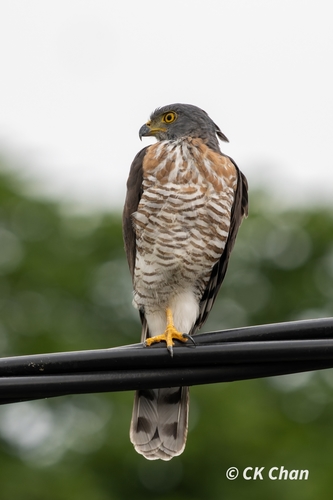
Crested Goshawk
Lophospiza trivirgata
The ghost of the canopy, the Crested Goshawk is a master of the ambush. With its distinctive short crest and piercing yellow gaze, this powerful raptor has become a surprising regular in urban backyards across Asia.
Quick Identification
Size
Length: 30–46 cm (12–18 in); Wingspan: 68–90 cm (27–35 in); Weight: 220–560 g (0.5–1.2 lbs)
Colors
Dark greyish-brown upperparts with a blackish crown; white underparts with a black throat stripe, rufous breast streaks, and heavy brown belly bars.
Key Features
- Prominent short, dark crest on the crown
- Bold black vertical stripe down the center of a white throat
- Short, rounded wings and a long tail with 3-4 dark bands
- Piercing yellow eyes and yellow legs
- Stocky build compared to other small hawks
When You’ll See Them
Geographic range
Where Does the Crested Goshawk Live?
The Crested Goshawk is a quintessentially Asian raptor, native to the lush tropical and subtropical regions of the southern continent. Its core range extends from the humid forests of the Indian subcontinent and Sri Lanka eastward across Southeast Asia, including the archipelagos of Indonesia and the Philippines. While primarily forest-dwellers, they have become remarkable success stories in urbanized areas like Singapore, Hong Kong, and Taiwan, where they patrol mature city parks and leafy residential neighborhoods.
Basemap © OpenStreetMap contributors
Behavior
The Crested Goshawk is a secretive and highly maneuverable predator that thrives in the dense canopy. Unlike many other hawks that soar in the open sky, this species prefers to remain hidden within the foliage, waiting patiently on a shaded branch before launching a sudden, explosive ambush on its prey. They are famously territorial and will vigorously defend their nesting sites from intruders, including larger birds of prey.
One of their most fascinating behaviors is the "shivering flight" display performed during the breeding season. The hawk will soar into the air and vibrate its wings rapidly while keeping them level, a visual signal used to mark territory and attract mates. In urban environments, they have become surprisingly bold, often nesting in mature trees within busy city parks or residential gardens where food is abundant.
EverydayEarth exclusive
Camera Tips
To capture a Crested Goshawk on your backyard or trail camera, focus on water rather than food. These hawks are fastidious bathers and will frequently visit shallow garden ponds or large bird baths to clean their feathers, especially during the heat of the afternoon. Position your camera at a low angle (about 1-2 feet off the ground) facing the water source, ensuring you have a wide enough frame to capture the splash of their large wings.
If you are placing a camera in a wooded area or a park, look for a 'kill pluck'—a flat branch or stump littered with feathers or fur. These are regular feeding stations. Mount your camera 4-6 feet high on an adjacent tree, angled slightly downward. Because these birds move with incredible speed, use a camera with a fast trigger speed (under 0.3 seconds) and set it to take a burst of 3-5 photos or high-frame-rate video (60fps) to avoid getting nothing but a blur of feathers.
Daylight is your best friend with this species. They are strictly diurnal, so there is no need to rely on heavy infrared flash at night. Instead, prioritize cameras with high-resolution sensors that perform well in the dappled, low-light conditions of a forest canopy. If your camera allows for it, increase the shutter speed to at least 1/500 to freeze their motion during a strike.
Finally, be patient and look for signs of their presence before setting your gear. Listen for their sharp 'ki-kee-ki-kee' calls or look for the 'whitewash' (droppings) at the base of large trees. In suburban settings, they often use the same transit routes every day; once you identify a flight path between two tall trees, you have found the perfect spot for a long-term camera setup.
Similar Species
Species that look similar or are commonly confused with Crested Goshawk.
Shikra
Smaller and more slender with a red eye in adults; lacks the Crested Goshawk's crest and dark throat stripe.
Besra
Very similar throat stripe, but Besra is much smaller with longer, thinner toes and lacks the crest.
Changeable Hawk-Eagle
Significantly larger with much longer legs and a more prominent crest; juveniles can look similar but have less defined barring.
Frequently Asked Questions
Record Crested Goshawk at your habitat
Connect a camera to start building your own species record — AI identifies every visitor automatically.