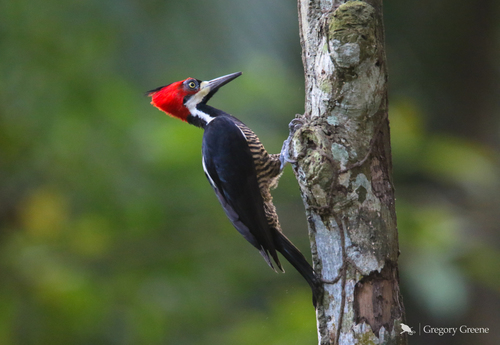
Crimson-crested Woodpecker
Campephilus melanoleucos
With its striking scarlet crest and powerful double-tap drum, the Crimson-crested Woodpecker is a magnificent sight in the tropical canopy. This master of the trunk is one of South America's most iconic and vocal forest residents.
Quick Identification
Size
Length of 33 to 38 cm (13 to 15 inches); weight ranges from 180 to 285 grams (6.3 to 10 oz)
Colors
Jet-black body with white stripes on the neck that meet to form a 'V' on the back. The head features a brilliant crimson-red crest. Males have a red patch on the cheek with a white center, while females have more black and white on the face and lack the red cheek patch.
Key Features
- Massive crimson-red triangular crest
- White 'V' pattern on a black back
- Powerful ivory-colored bill
- Distinctive 'double-tap' drumming sound
When You’ll See Them
Geographic range
Where Does the Crimson-crested Woodpecker Live?
The Crimson-crested Woodpecker is a widespread resident of Central and South America. Its range begins in the lush forests of Panama and extends across nearly every mainland South American country, including Colombia, Venezuela, Brazil, and northern Argentina. While they are common across the Amazon basin and the Guianas, they are notably absent from the high Andes and the southern reaches of Chile and Uruguay.
Basemap © OpenStreetMap contributors
Behavior
The Crimson-crested Woodpecker is a high-energy bird known for its powerful presence in the canopy and mid-story of the forest. They are often found in pairs or small family groups, maintaining a territory with loud, resonant drumming. Their signature 'double-tap'—two rapid, hard strikes against a hollow tree—serves as both a territorial claim and a way to communicate with their mate. Unlike some smaller woodpeckers, their movements are deliberate and strong, hitching up tree trunks with jerky, confident hops.
While they are primarily forest birds, they are surprisingly adaptable and will venture into large gardens or suburban areas that border woodlands. They are not particularly shy but tend to stay high enough in the trees to remain out of direct reach of humans. When foraging, they use their massive bills to excavate deep into decaying wood, often leaving behind large, rectangular holes that serve as evidence of their passing long after the bird has flown.
EverydayEarth exclusive
Camera Tips
To capture a Crimson-crested Woodpecker on your AI camera, focus on 'snags'—standing dead trees—within or near your yard. These birds are excavators by nature; they seek out decaying wood where beetle larvae thrive. Position your camera about 6 to 10 feet up a tree trunk, angled slightly upward if you are aiming at a known drumming spot. If your camera has a 'propped' or 'fast-trigger' mode, use it; their head movements during drumming are incredibly fast and can result in motion blur on slower shutters.
Lighting is crucial for this species. Because they have deep black plumage and a bright red crest, they can easily appear as a dark silhouette in shadows or 'blown out' in direct, harsh midday sun. Aim your camera toward the west or east to catch the softer morning or late afternoon light, which will make that crimson crest pop against the forest background. If you have a water feature or a large bird bath, a camera placed nearby might catch them coming down for a drink, though they are more likely to be seen on vertical trunks.
In terms of settings, video is highly recommended over still photos. The sound of their double-tap is one of the most iconic sounds of the neotropics, and a video clip will capture both the visual spectacle and the acoustic signature of the species. Set your video length to at least 15-20 seconds to ensure you catch the full foraging cycle. If you live in an area where they are common, you can sometimes lure them into camera range using high-quality suet feeders, provided the feeders are securely mounted to a large, stable tree trunk that mimics their natural foraging surface.
Similar Species
Species that look similar or are commonly confused with Crimson-crested Woodpecker.
Lineated Woodpecker
The Lineated has white facial stripes that start at the bill, whereas the Crimson-crested's stripes start further back on the neck and form a prominent 'V' on its back.
Guayaquil Woodpecker
Found mostly in western Ecuador and Peru, it has a paler face and different barring on the underparts compared to the Crimson-crested.
Frequently Asked Questions
Record Crimson-crested Woodpecker at your habitat
Connect a camera to start building your own species record — AI identifies every visitor automatically.