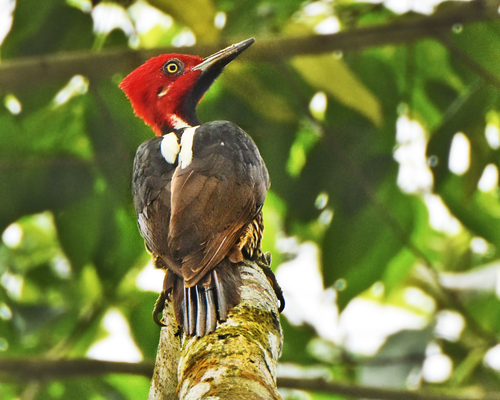
Guayaquil Woodpecker
Campephilus gayaquilensis
A striking specialist of the Tumbesian forests, the Guayaquil Woodpecker is famous for its vibrant red crest and thunderous drumming that echoes through the canopy.
Quick Identification
Size
Length of 32 to 34 cm (12.6 to 13.4 inches); weight approximately 230 to 250 grams (8.1 to 8.8 ounces).
Colors
Glossy black upperparts with a white 'V' on the back; bright red crest; barred buff and black underparts. Males feature a red cheek patch, while females have a broad white stripe on the face.
Key Features
- Pointed, fiery red crest
- Distinctive white 'V' pattern on the back
- Pale ivory-colored bill
- Barred black and cream belly
When You’ll See Them
Geographic range
Where Does the Guayaquil Woodpecker Live?
Native to the South American continent, the Guayaquil Woodpecker is a specialist of the Tumbesian region. Its core range is concentrated along the Pacific slope, extending from western Ecuador down into the northwestern tip of Peru. While it thrives in the humid and dry forests of these coastal lowlands, it is increasingly confined to protected pockets of habitat due to local deforestation.
Basemap © OpenStreetMap contributors
Behavior
The Guayaquil Woodpecker is a charismatic and high-energy resident of the equatorial forests. Known for its powerful drumming, this species typically moves in pairs or small family groups, communicating through loud, nasal calls and a distinctive 'double-tap' drum that can echo through the canopy for hundreds of yards. They are highly territorial and will defend their nesting sites in large, decaying trees with vigor.
While they are wary of human presence, they have adapted to forest fragments and occasionally venture near rural dwellings with mature trees. Their foraging style is intense; they use their powerful bills to peel back bark and excavate deep into soft wood. Observing them is often a matter of following the sound of falling wood chips and rhythmic tapping.
EverydayEarth exclusive
Camera Tips
To capture the Guayaquil Woodpecker, camera placement is everything. You should look for 'snags'—standing dead trees—that show signs of recent excavation, such as fresh wood chips at the base or deep, rectangular holes. Mount your camera at least 6 to 10 feet up the trunk of a neighboring tree, angled slightly downward toward a known foraging site. Because these birds are large, ensure your camera is positioned far enough back (about 10-15 feet) to keep their full wingspan in the frame if they take flight.
Use a high-sensitivity PIR sensor setting, as these birds move with quick, hitching motions that can trigger late if the camera isn't responsive. If your AI-powered camera supports video, prioritize 20-30 second clips. The audio is just as important as the visual; the Guayaquil Woodpecker's 'double-tap' drum is a key diagnostic feature and provides a wonderful acoustic record of the species' presence.
Timing is crucial; they are most active shortly after sunrise when they begin their first foraging rounds. Avoid placing cameras in direct midday sun, as the high contrast can wash out the white 'V' on their backs, making identification harder. In suburban or rural backyard settings near forest edges, providing a water source or a tall, safe snag can encourage them to linger within the camera's field of view.
Similar Species
Species that look similar or are commonly confused with Guayaquil Woodpecker.
Frequently Asked Questions
Record Guayaquil Woodpecker at your habitat
Connect a camera to start building your own species record — AI identifies every visitor automatically.