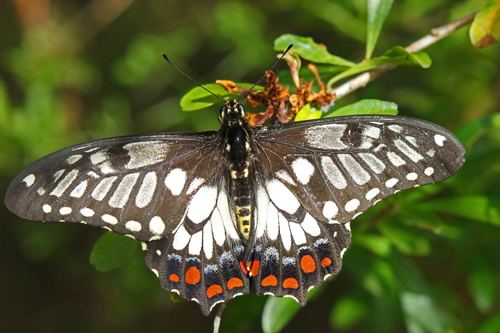
Dainty Swallowtail
Papilio anactus
A striking native Australian butterfly, the Dainty Swallowtail brings a splash of monochrome elegance and red-spotted flair to backyard citrus trees. Despite its name, this resilient flyer is a master of mimicry and a frequent visitor to suburban gardens across the continent.
Quick Identification
Size
Wingspan of 65-75 mm (2.5-3.0 inches); body length approx 30-40 mm (1.2-1.6 inches)
Colors
Black wings with creamy-white patches; hindwings feature a distinct row of red and blue crescent spots
Key Features
- Large white rectangular patches on black forewings
- Row of red and blue spots along hindwing margins
- Lacks the long 'tails' seen on other swallowtail species
- Caterpillars mimic bird droppings when young, turning green with yellow spots as they mature
When You’ll See Them
Geographic range
Where Does the Dainty Swallowtail Live?
This butterfly is a proud endemic of Australia, found primarily along the eastern coast and throughout the southern regions of the continent. Its territory stretches from the tropical reaches of Queensland down through New South Wales and Victoria, reaching as far west as the Eyre Peninsula in South Australia. While it thrives in wild woodland edges, its range has expanded significantly into urban metropolitan areas due to the widespread planting of citrus trees in residential backyards.
Basemap © OpenStreetMap contributors
Behavior
The Dainty Swallowtail is a fast and erratic flier, often seen darting through suburban gardens and citrus groves with a characteristic fluttering motion. They are particularly active during the warmest parts of the day, frequently pausing to hover over nectar-rich flowers. This species is a master of mimicry; its wing patterns closely resemble those of the toxic Clearwing Swallowtail, a strategy known as Batesian mimicry that helps protect it from hungry birds.
Socially, the males are highly territorial and engage in a behavior known as 'hilltopping.' They will fly to the highest point in the immediate landscape—be it a literal hill or the canopy of a tall garden tree—to patrol the area and wait for females. When threatened in their larval stage, the caterpillars can extrude a foul-smelling, Y-shaped orange organ called an osmeterium from behind their heads, which emits a pungent citrus-like odor to ward off predators.
EverydayEarth exclusive
Camera Tips
To capture the Dainty Swallowtail on an AI-powered camera, placement is the most critical factor. Since these butterflies are biologically tied to their host plants, mount your camera approximately 1 to 1.5 meters off the ground, angled slightly downward toward the fresh, soft growth of a lemon, lime, or orange tree. This is where females are most likely to land for egg-laying, providing the best chance for still shots while they are momentarily stationary.
If you don't have a citrus tree, focus your camera on 'nectar stations.' Dainty Swallowtails are particularly fond of purple and red flowers; positioning your lens near Buddleia (Butterfly Bush), Lantana, or native Grevilleas will yield excellent results. Because they are rapid, erratic fliers, set your camera to its highest possible shutter speed or 'Sports/Action' mode to avoid motion blur. If your camera allows for interval shooting, set it to trigger every few seconds when motion is detected to capture the perfect wing-open pose.
Lighting is another vital consideration in the harsh Australian sun. Try to position your camera so the sun is behind the lens or hitting the subject from the side. Direct midday sun on the bright white patches of their wings can cause overexposure, losing the fine detail of the wing veins. For those interested in the 'complete story,' place a secondary camera on a steady tripod very close to a citrus branch to document the fascinating larval stages, as the caterpillars are much slower and easier to photograph than the elusive adults.
Similar Species
Species that look similar or are commonly confused with Dainty Swallowtail.
Frequently Asked Questions
Record Dainty Swallowtail at your habitat
Connect a camera to start building your own species record — AI identifies every visitor automatically.