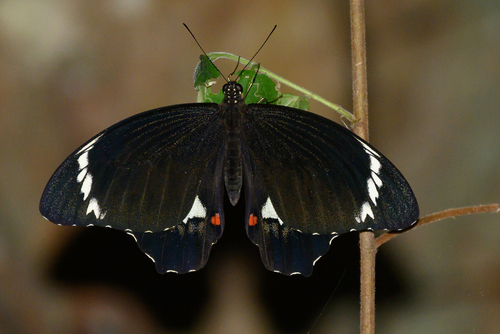
Orchard Swallowtail
Papilio aegeus
Australia's largest common butterfly, the Orchard Swallowtail, is a spectacular garden visitor known for its bold black-and-white patterns and its love for backyard citrus trees.
Quick Identification
Size
Wingspan 100-140 mm (4-5.5 inches)
Colors
Sexually dimorphic: Males are black with white wing patches and a white hindwing band; females are brownish-black with large cream patches, red and blue spots.
Key Features
- Large, scalloped hindwings without long tails
- Males feature a prominent white band across the hindwing
- Females have complex cream, red, and blue markings
- Larvae resemble bird droppings in early stages
When You’ll See Them
Geographic range
Where Does the Orchard Swallowtail Live?
The Orchard Swallowtail is native to the Oceania region, predominantly found across the eastern half of Australia and Papua New Guinea. Its core range spans from the tropical northern reaches of Queensland down through New South Wales and into eastern Victoria. Because it has adapted so successfully to cultivated citrus trees, it is now one of the most common large butterflies found in major Australian metropolitan areas and coastal suburban stretches.
Basemap © OpenStreetMap contributors
Behavior
The Orchard Swallowtail is a powerful and visible flier, often seen gliding through suburban gardens with a characteristic 'bobbing' motion. They are highly active during the warmest parts of the day, with males frequently observed defending territories or patrolling 'flight paths' along forest edges and garden boundaries. Despite their large size, they are quite agile, capable of hovering briefly while sipping nectar from deep-throated flowers.
One of their most famous behaviors is the defensive strategy of their larvae. When disturbed, the caterpillars extend a bright orange, Y-shaped organ called an osmeterium from behind their head, which releases a pungent, citrusy odor to deter predators. Adult females are discerning mothers, spending significant time hovering around citrus trees to find the perfect tender new growth on which to deposit their eggs.
EverydayEarth exclusive
Camera Tips
To capture high-quality images of the Orchard Swallowtail, position your AI camera near its favorite host plants—specifically lemon, lime, or orange trees. Females frequent these trees to lay eggs on fresh, light-green shoots, providing excellent opportunities for close-up shots. Set your camera at a height of 3 to 5 feet, focusing on the outer canopy of the citrus tree where the most new growth occurs.
Lighting is the most critical factor for this species. Orchard Swallowtails are solar-powered and most active in bright, direct sunlight. Place your camera in a spot that catches the morning sun, as this is when they are most likely to bask with their wings spread to warm up. If you are using a trigger-based camera, ensure the sensitivity is high and the shutter speed is fast; their flight is erratic and they rarely stay still for long while feeding.
For the best variety of shots, place a 'butterfly bar' nearby—a shallow dish with overripe fruit or a sponge soaked in sugar water. This can lure them into a stationary position for longer periods. Additionally, planting nectar-rich flowers like Pentas, Ixora, or Buddleia in the camera's field of view will encourage them to linger. If you want to capture the lifecycle, try time-lapse settings on a specific branch where you've spotted the bird-dropping-mimic caterpillars; they grow rapidly and provide fascinating daily updates.
Similar Species
Species that look similar or are commonly confused with Orchard Swallowtail.
Frequently Asked Questions
Record Orchard Swallowtail at your habitat
Connect a camera to start building your own species record — AI identifies every visitor automatically.