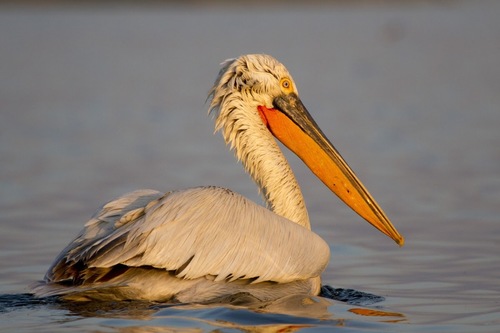
Dalmatian Pelican
Pelecanus crispus
The Dalmatian Pelican is an avian heavyweight with a prehistoric silhouette and a magnificent 'curly' crest. As one of the largest flying birds on Earth, its presence transforms any wetland into a scene from a lost world.
Quick Identification
Size
160-183 cm (63-72 in) long; wingspan 2.7-3.2 m (8.9-10.5 ft); weight 9-15 kg (20-33 lbs)
Colors
Silvery-white plumage with greyish wing tips; lead-grey legs; pouch turns bright orange-red during breeding season
Key Features
- Distinctive 'curly' feathers on the nape and crown
- Enormous bill with a pouch that turns orange-red in spring
- Massive wingspan ranking among the largest of all flying birds
- Pale silvery-grey plumage compared to the pinkish-white of Great White Pelicans
When You’ll See Them
Geographic range
Where Does the Dalmatian Pelican Live?
Native to the vast wetlands of Central Eurasia, the Dalmatian Pelican's range stretches from the Balkan Peninsula and the eastern Mediterranean across to the Taiwan Strait. Its core populations are found in countries like Greece, Romania, Russia, and Kazakhstan, where it frequents massive inland lakes and river deltas. During the winter, these birds are short-to-medium distance migrants, moving south to the warmer coastal waters of the Persian Gulf, India, and south-eastern China to avoid frozen northern waters.
Basemap © OpenStreetMap contributors
Behavior
Dalmatian Pelicans are social birds, though they are notably less gregarious than their Great White cousins. They are often seen soaring gracefully on thermals or swimming in small, synchronized groups. While they frequently nest in colonies, they are also comfortable foraging alone. These birds are generally silent, though they may produce various grunts and hisses during the breeding season at the nesting site.
In terms of human interaction, they are sensitive to disturbance, particularly during the nesting phase. However, in some regions like Lake Kerkini in Greece, they have become somewhat accustomed to local fishermen, occasionally following boats for easy scraps. Despite their heavy weight, they are surprisingly agile in the air and are masters of utilizing wind currents to travel long distances with minimal effort.
EverydayEarth exclusive
Camera Tips
When setting up an AI-powered camera to capture a Dalmatian Pelican, placement is everything. These birds spend the majority of their time on the water or resting on low-lying islands and sandbars. Position your camera at a low angle near the water's edge, ideally on a tripod or a secure mount just above the high-water mark. Aim for areas where you see 'whitewash' (droppings) on rocks or logs, as these are preferred loafing spots where the birds preen and rest between fishing trips.
Lighting is a significant challenge because of their bright, silvery-white plumage. To avoid 'blowing out' the highlights (where the bird looks like a featureless white blob), set your camera to underexpose slightly if possible, or position it so the sun is at your back during the golden hours of early morning. This direction of light will highlight the texture of their unique curly head feathers and the vibrant orange of their pouches during the spring months. High-speed shutter settings are essential if your camera allows them, as even a slow-moving pelican has a massive wingspan that can cause motion blur during take-off.
Because these birds are sensitive to movement, using a camera with a long focal length or a high-resolution sensor for cropping is better than placing a camera too close to a nesting site. Never approach an active nest, as Dalmatian Pelicans are known to abandon eggs if they feel threatened. Instead, focus on 'flight paths' over open water or popular fishing spots. If you are on a private dock or wetland property, providing a stable wooden platform just above the water level can act as a natural 'lure,' as they are always looking for safe places to dry their wings away from ground predators.
Similar Species
Species that look similar or are commonly confused with Dalmatian Pelican.
Frequently Asked Questions
Record Dalmatian Pelican at your habitat
Connect a camera to start building your own species record — AI identifies every visitor automatically.