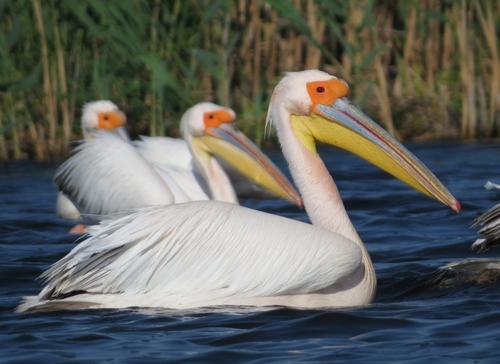
Great White Pelican
Pelecanus onocrotalus
With a wingspan that rivals the world's largest birds, the Great White Pelican is a master of the wetlands. Watch as these social giants glide in formation across the water's surface, working together in a synchronized dance to harvest the day's catch.
Quick Identification
Size
Length 140-180 cm (55-71 in); Wingspan 226-360 cm (7.4-11.8 ft); Weight 9-15 kg (20-33 lbs)
Colors
Adults are pure white, often with a pinkish flush during breeding; black primary and secondary wing feathers; yellow or pinkish facial skin and throat pouch
Key Features
- Massive wingspan among the largest of all living birds
- Huge yellow elastic throat pouch used for fishing
- Long, flattened bill (30-45 cm) with a small terminal hook
- Social cooperative hunting behavior in flocks
When You’ll See Them
Geographic range
Where Does the Great White Pelican Live?
The Great White Pelican boasts a sprawling range that stretches from southeastern Europe through western and central Asia, and across much of sub-Saharan Africa. In Europe, the Danube Delta serves as a critical breeding stronghold, while in Africa, they are commonly found in the Great Rift Valley lakes and coastal regions of South Africa. While Asian and European populations are largely migratory, traveling south for the winter, many African populations remain resident or move nomadically based on local water levels and fish availability.
Basemap © OpenStreetMap contributors
Behavior
The Great White Pelican is an incredibly social bird, rarely seen alone. They are famous for their cooperative hunting strategy, where a flock will form a horseshoe shape or a line on the water's surface, beating their wings and splashing to drive fish into shallower waters. Once the fish are concentrated, the pelicans dip their massive bills in unison to scoop up their prey. This social coordination makes them one of the most efficient avian fishers on the planet.
On land, they are somewhat clumsy and gregarious, often congregating in massive breeding colonies that can number in the thousands. Despite their size, they are masters of thermals, capable of soaring to great heights and traveling over 100 kilometers in a single day to find food. While they are generally quiet birds, they do produce a variety of deep grunts and growls at their nesting sites, particularly during the breeding season when competition for space and mates is high.
EverydayEarth exclusive
Camera Tips
To capture the majesty of a Great White Pelican, camera placement is everything. These birds are most predictable at 'loafing' spots—sandbars, flat rocks, or shoreline edges where they gather to preen and rest after fishing. Position your camera at a low angle, roughly 1-2 feet off the ground, to get an intimate perspective that emphasizes their massive size. Since they are large and white, they can easily 'blow out' in bright sunlight; try to angle your camera so it faces away from the direct midday sun, or look for spots with early morning backlighting to capture the pinkish glow of their feathers.
Because pelicans are highly social, a wide-angle lens is often better than a narrow telephoto if your camera allows for it. This helps you capture the group dynamics of their cooperative hunting. If you are setting up near a water source, ensure your camera has a high-speed trigger. While they look slow when floating, their strike—the moment they plunge their bill into the water—is lightning fast. A trigger speed of 0.2 seconds or less is ideal for catching the water droplets and the expansion of the throat pouch.
Avoid trying to 'bait' these birds with store-bought fish, as this can disrupt their natural foraging habits and lead to dependency. Instead, look for natural 'funnels' in the landscape, such as narrow channels between ponds or shallow areas where fish naturally congregate. These are the spots where pelicans will return day after day. During the breeding season, look for high-vantage points overlooking islands; pelicans prefer nesting in areas inaccessible to land predators, and a camera placed on a nearby shore overlooking an island can provide incredible footage of their social interactions.
Similar Species
Species that look similar or are commonly confused with Great White Pelican.
Dalmatian Pelican
Slightly larger with silvery-grey plumage, curly nape feathers, and grey legs instead of pink.
Pink-backed Pelican
Much smaller in size with a greyish-white back and a lack of the bold black wing-feather contrast seen in the Great White.
American White Pelican
Found only in North America; develops a prominent 'horn' on the upper bill during the breeding season.
Frequently Asked Questions
Record Great White Pelican at your habitat
Connect a camera to start building your own species record — AI identifies every visitor automatically.