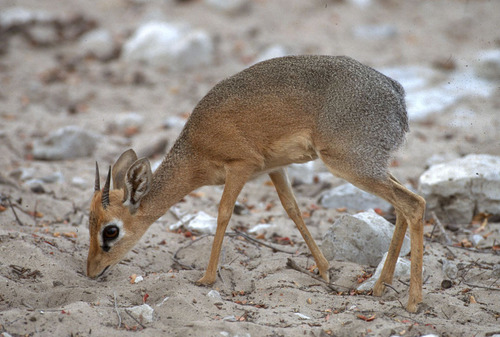
Damara Dik-dik
Madoqua damarensis
The Damara Dik-dik is a miniature marvel of the African bush, known for its trunk-like snout and lifelong devotion to its mate. This tiny, elusive antelope is a master of camouflage in the rocky scrublands of Namibia.
Quick Identification
Size
Height: 35-45 cm (14-18 in); Length: 55-72 cm (22-28 in); Weight: 3.5-5.5 kg (7.7-12 lbs)
Colors
Grizzled grey to reddish-brown upper body with a pale, creamy white belly; distinctive white ring around the eyes
Key Features
- Flexible, elongated snout used for thermoregulation
- Short, straight, spiked horns on males (4-9 cm)
- Large black preorbital glands appearing as dark slits below the eyes
When You’ll See Them
Geographic range
Where Does the Damara Dik-dik Live?
The Damara Dik-dik is a specialist of the southwestern African wilds. Its native range is concentrated in the arid and semi-arid regions of central and northern Namibia, extending northward into the southwestern corner of Angola. They are uniquely adapted to the rugged terrains of the Kunene and Erongo regions, where they favor areas with enough brush to provide both food and concealment from predators.
Basemap © OpenStreetMap contributors
Behavior
The Damara Dik-dik is a highly territorial antelope that lives in stable, monogamous pairs. Unlike many other ungulates, they do not form herds; instead, a male and female will defend a specific territory for life, marking their boundaries frequently using scent from their preorbital glands. They are incredibly shy and elusive, often freezing in place to blend into the scrub or making a characteristic 'zik-zik' alarm call while zig-zagging away at high speeds when threatened.
These tiny antelopes are most active during the cooler hours of the early morning and late afternoon, though they may become more nocturnal during periods of extreme heat or full moons. They spend a significant portion of their day ruminating in the shade of thickets. Because they derive most of their moisture from their food, they are rarely seen at waterholes, making them masters of the arid Namibian landscapes where they thrive away from human settlements.
EverydayEarth exclusive
Camera Tips
To capture the Damara Dik-dik, camera placement is everything. Since these are among the smallest antelopes in the world, your camera should be mounted very low to the ground—ideally no higher than 30 to 40 centimeters (12-16 inches). This 'ant's-eye view' ensures you capture the face and the distinctive snout rather than just the tops of their backs. Angle the camera slightly upward if you are placing it on a slope.
Look for 'dung middens' or scent-marking sites. Dik-diks are creatures of habit and will return to the same spots daily to defecate or rub their preorbital glands on low-hanging twigs to mark their territory. If you find a small pile of tiny, pellet-like dung or a branch that looks particularly smoothed over at Dik-dik eye level, you have found a goldmine for camera placement. Avoid using edible bait, as they are picky browsers, but the natural lure of a territorial marking post is unbeatable.
Because they are most active during the crepuscular hours (dawn and dusk) and sometimes at night, ensure your camera has a high-quality infrared flash that won't spook them. Fast trigger speeds are essential; when a Dik-dik moves, it moves quickly and erratically. Set your camera to take a burst of 3-5 photos or a short video clip to catch their nervous, twitching nose movements and social interactions between the mated pair.
Similar Species
Species that look similar or are commonly confused with Damara Dik-dik.
Frequently Asked Questions
Record Damara Dik-dik at your habitat
Connect a camera to start building your own species record — AI identifies every visitor automatically.