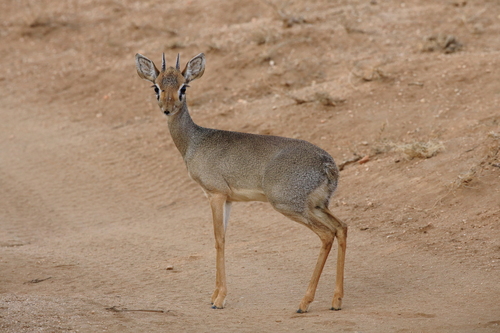
Kirk's Dik-dik
Madoqua kirkii
A miniature marvel of the African savanna, Kirk's Dik-dik is a monogamous antelope known for its trunk-like nose and incredible agility. Though small in stature, these territorial residents are masters of survival in the scrublands.
Quick Identification
Size
55-77 cm (22-30 in) in length; 35-45 cm (14-18 in) shoulder height; weighs 2.7-6.5 kg (6-14 lbs)
Colors
Yellowish-gray to reddish-brown fawn coat with white underparts. Males feature short, spiked horns and a dark tuft of hair.
Key Features
- Elongated, mobile snout used for heat regulation
- Prominent tuft of upright hair on the forehead
- Large, dark eyes surrounded by a white ring
- Tiny, straight horns up to 11 cm long (males only)
When You’ll See Them
Sightings on EverydayEarth
Jun 24, 2026
A group of Helmeted Guineafowl forages in a woodland clearing, pecking at the ground for seeds and insects. Nearby, a pair of Kirk's Dik-diks graze cautiously, their large ears twitching as they move through the sparse vegetation.
Geographic range
Where Does the Kirk's Dik-dik Live?
Native to the African continent, Kirk's Dik-dik is found in two geographically separated populations. The largest population inhabits Eastern Africa, spanning across Kenya, Tanzania, central and southern Somalia, and parts of Ethiopia. A separate, distinct population thrives in the southwestern corner of the continent, primarily within Namibia and southern Angola, favoring the dry, scrub-filled landscapes of these regions.
Basemap © OpenStreetMap contributors
Behavior
Kirk's Dik-diks are fascinating for their social structure, being one of the few antelope species that form lifelong monogamous pairs. They are highly territorial, with pairs occupying the same patch of land for their entire lives. They mark their territory meticulously using secretions from the preorbital glands located below their eyes, as well as communal dung heaps known as middens.
When threatened, these tiny antelopes do not rely on size for defense. Instead, they use their incredible speed—reaching up to 42 km/hour—and a distinctive zig-zagging flight pattern to confuse predators. They are known for their 'zik-zik' alarm call, which warns other animals of danger. While they are generally shy and prefer the safety of thickets, they can become somewhat accustomed to human presence in quiet suburban areas or protected lodges.
EverydayEarth exclusive
Camera Tips
When setting up a camera for Kirk's Dik-dik, height is your most important variable. These are very small animals; if your camera is mounted at the standard 'deer height' (3-4 feet), you will likely only capture the tops of their heads or miss them entirely. Mount your AI-powered camera just 8 to 12 inches off the ground. Angle the lens slightly upward to capture their unique facial features and mobile snouts, which are their most identifying characteristics.
Placement is best near 'territory markers.' Look for low-hanging branches that appear blackened or waxy—these are often used for scent marking. Dik-diks also use communal dung middens, returning to the same spots daily. Placing a camera near one of these middens or along a well-trodden 'game trail' through thick brush will almost guarantee a capture. They are creatures of habit, so once you find a spot they frequent, keep your camera there.
Because Dik-diks are most active during the 'golden hours' of dawn and dusk, ensure your camera's sensor is sensitive to low-light conditions. High trigger speeds are essential; they are incredibly skittish and can bound out of frame in less than a second. Setting your camera to take a 3-shot burst or a 15-second video will allow you to see their social interactions, such as a male following a female or the peculiar way they use their trunks to forage for fallen seeds.
Similar Species
Species that look similar or are commonly confused with Kirk's Dik-dik.
Damara Dik-dik
Often considered a subspecies, it is slightly larger and found exclusively in Southwestern Africa.
Steenbok
Lacks the elongated snout and forehead tuft; has much larger, broad ears.
Klipspringer
Found in rocky terrain rather than scrub; has a much coarser, 'peppered' coat and stands on the tips of its hooves.
Frequently Asked Questions
Record Kirk's Dik-dik at your habitat
Connect a camera to start building your own species record — AI identifies every visitor automatically.