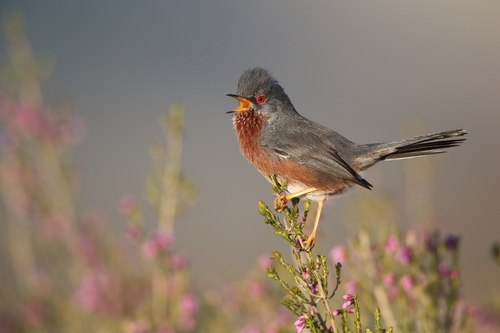
Dartford Warbler
Curruca undata
A hardy survivor of the windswept heath, the Dartford Warbler is famous for its striking red eye and deep burgundy breast. Unlike most warblers, this tiny, long-tailed specialist stays put all winter, braving the elements in its thorny gorse fortress.
Quick Identification
Size
Length: 12-13 cm (4.7-5.1 in); Wingspan: 13-19 cm (5.1-7.5 in); Weight: 8-12 g (0.28-0.42 oz)
Colors
Adult males feature slate-grey upperparts, deep burgundy-red underparts, and a white-flecked throat. Females and juveniles are browner above and a paler, sandy-orange below.
Key Features
- Long, thin tail often held cocked at an angle
- Bright red eye-ring and iris in adults
- Deep reddish-brown breast and throat with white speckling
- Restless, skulking movement through dense scrub
When You’ll See Them
Geographic range
Where Does the Dartford Warbler Live?
The Dartford Warbler is native to the temperate western fringes of Europe and parts of Northwest Africa. Its core population resides in Spain, Portugal, and France, with significant but more localized populations in the southern United Kingdom and Italy. While it is primarily a Mediterranean species, it has expanded its northern reaches in recent decades, though it remains strictly tied to coastal and lowland heath habitats within these countries.
Basemap © OpenStreetMap contributors
Behavior
The Dartford Warbler is a notoriously elusive bird, often described as a 'skulker' because it spends much of its time hidden deep within dense, prickly vegetation. Unlike many other warblers that migrate to Africa for the winter, the Dartford Warbler is a hardy resident in much of its range, though this makes it highly vulnerable to particularly harsh winters. It is an active, restless bird, constantly flitting between bushes with a distinctive, jerky flight pattern.
Socially, these birds are highly territorial during the breeding season. Males can be seen singing from the tops of gorse or heather stems to defend their patch, though they quickly dive for cover if disturbed. While they are not particularly bold around humans, they can become accustomed to observers who remain quiet and still near their heathland territories.
EverydayEarth exclusive
Camera Tips
Capturing a Dartford Warbler on camera requires precision and patience because they rarely venture into the open. The best strategy is to identify a 'song post'—usually the tallest sprig of gorse or a prominent branch in a patch of heather—where the male sits to sing. Position your camera at a slight upward angle, roughly 1 to 1.5 meters away from these perches. Because these birds are small and move with lightning speed, use the highest possible shutter speed and set your AI trigger sensitivity to 'High' to avoid missing the action.
In terms of placement, height is critical. If you are targeting foraging behavior, place the camera low to the ground (about 30-50 cm high) facing a small clearing or 'corridor' between dense gorse bushes. Dartford Warblers often hop along the ground or low branches looking for spiders. Avoid using heavy baits; instead, a shallow, natural-looking birdbath placed near dense cover can be an irresistible draw during dry spells, as these birds need to drink and bathe but hate being far from safety.
Early morning light is your best friend for these birds. The deep reds and greys of the male's plumage are subtle and can look washed out in midday sun or muddy in low light. Position your camera facing north or south to avoid direct lens flare during the golden hours. If your camera supports burst mode, enable it; a single frame often catches only a tail or a blurry wing as they dive back into the thorns.
Similar Species
Species that look similar or are commonly confused with Dartford Warbler.
Frequently Asked Questions
Record Dartford Warbler at your habitat
Connect a camera to start building your own species record — AI identifies every visitor automatically.