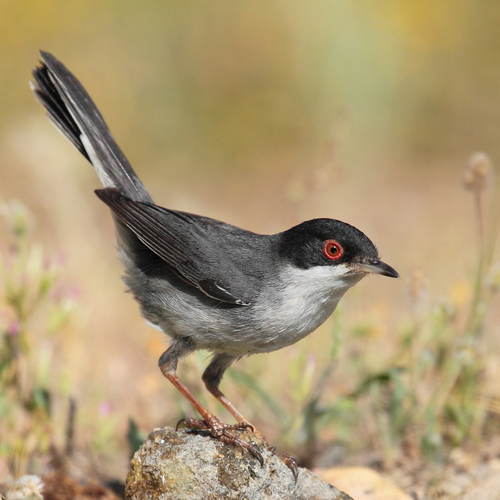
Sardinian Warbler
Curruca melanocephala
With his dapper black cap and fiery red eyes, the Sardinian Warbler is the charismatic soundtrack of the Mediterranean scrub. A restless and bold garden visitor, this hardy warbler is a year-round delight for backyard birdwatchers.
Quick Identification
Size
13–14 cm (5–5.5 in) in length; 15–18 cm (6–7 in) wingspan; weight 12–25 g (0.4–0.9 oz)
Colors
Males have a jet-black head, white throat, and slate-grey back. Females are browner with a greyish head. Both sexes feature a prominent red orbital ring.
Key Features
- Striking bright red ring around the eye
- Male's velvet-black cap contrasting with a clean white throat
- Long, dark tail with white outer edges frequently cocked or flicked
- Restless, energetic movement through dense scrub
When You’ll See Them
Geographic range
Where Does the Sardinian Warbler Live?
Native to the Mediterranean basin, the Sardinian Warbler is the most characteristic warbler of Southern Europe and North Africa. Its core range extends from the sun-drenched hills of Portugal and Spain through the coastal regions of France, Italy, Greece, and Turkey, reaching as far as the Levant and the northern fringes of the Sahara. While mostly a resident bird, some northern populations may move short distances south during particularly harsh winters, and it is increasingly appearing as a vagrant in Northern Europe.
Basemap © OpenStreetMap contributors
Behavior
The Sardinian Warbler is a quintessential Mediterranean spirit—restless, vocal, and full of character. These birds are notorious 'skulkers,' preferring to move through the thickest parts of hedges and shrubs. They are rarely still for long, often seen darting between cover with a distinctive, jerky flight pattern and a cocked tail that reveals white outer feathers. While they can be shy, their curiosity often brings them to the edge of the vegetation to investigate intruders with a sharp, rattling scold.
Socially, they are typically seen in pairs or small family groups. They are highly territorial during the breeding season, with males performing a fluttering song-flight to defend their patch of scrub. Unlike many other warblers that migrate long distances, the Sardinian Warbler is largely a resident species, staying in the same general area year-round, which makes them a reliable visitor for backyard observers in southern Europe.
EverydayEarth exclusive
Camera Tips
To capture the Sardinian Warbler on a backyard camera, placement is everything. These birds rarely venture into wide-open spaces, so position your camera near dense, 'leafy' corridors like ivy-covered walls, thick hedges, or bramble patches. Set the camera at a low to mid-height (1 to 1.5 meters) and angle it slightly upward to catch them as they forage for insects on the underside of leaves or hop along lower branches.
Water is a massive draw for this species. A shallow birdbath or a dripping water feature placed near cover is your best bet for a clear shot. Because they are incredibly fast and twitchy, ensure your camera is set to its fastest trigger speed. If your device allows for 'burst mode,' use it; a single photo will often catch them mid-blur, but a sequence of three to five shots is likely to yield that perfect, sharp image of the male's striking red eye.
During the winter months, you can entice them into the camera's frame by providing fruit-based suet or even halved figs and grapes. They are less likely to visit traditional seed feeders, so focusing on natural-style perches near fruit sources will provide more authentic footage. Early morning light is particularly flattering for capturing the contrast between the male's black cap and white throat, so try to face your camera north or south to avoid direct lens flare during these peak activity hours.
Similar Species
Species that look similar or are commonly confused with Sardinian Warbler.
Frequently Asked Questions
Record Sardinian Warbler at your habitat
Connect a camera to start building your own species record — AI identifies every visitor automatically.