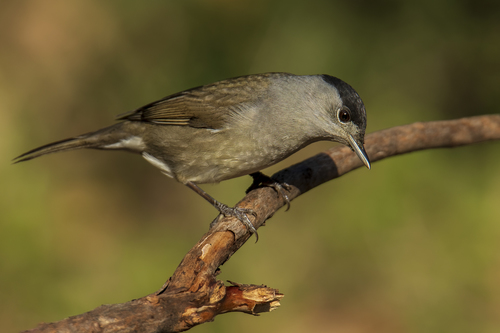
Eurasian Blackcap
Sylvia atricapilla
With its soulful, fluting song and stylish 'skull cap,' the Eurasian Blackcap is the crown jewel of the European garden. Whether it's a black-capped male or a chestnut-capped female, these agile warblers are a delight for any backyard birdwatcher.
Quick Identification
Size
Length of 13-15 cm (5.1-5.9 inches) with a wingspan of 20-23 cm (7.8-9.1 inches); weighs between 14-25 grams (0.5-0.9 ounces).
Colors
Olive-grey upperparts and pale grey underparts; males feature a signature black cap, while females and juveniles have a bright reddish-brown cap.
Key Features
- Distinctive neat cap (black for males, brown for females)
- Small, thin dark bill adapted for insects and berries
- Plumage lacks any bold wing bars or tail patterns
- Energetic, flitting movements through dense foliage
When You’ll See Them
Geographic range
Where Does the Eurasian Blackcap Live?
This resilient warbler is native across the vast expanse of Europe, stretching from the British Isles and Scandinavia down to the Mediterranean and North Africa. It also extends eastward into Western Asia, reaching as far as the Caspian Sea and parts of Siberia. While many populations migrate to warmer climates in the south for winter, an increasing number of Central European birds now head to North-Western Europe to take advantage of milder winters and garden bird feeders.
Basemap © OpenStreetMap contributors
Behavior
The Eurasian Blackcap is a master of the undergrowth, often heard before it is seen. Known as the 'Northern Nightingale,' its song is a rich, flute-like warble that adds a melodic backdrop to European gardens. While they are technically warblers, their behavior shifts significantly with the seasons. In the spring and summer, they are territorial and primarily insectivorous, flitting through the canopy to catch flies and caterpillars.
Interestingly, Blackcaps have become a fascinating case study in evolution and human interaction. In recent decades, many have adapted their migration patterns to winter in suburban gardens, particularly in the UK, where they rely heavily on bird feeders. They can be quite assertive at feeding stations, often defending a patch of suet or sunflower hearts from larger birds. Despite their small size, they are hardy and surprisingly bold once they establish a territory.
EverydayEarth exclusive
Camera Tips
To capture the Eurasian Blackcap, placement is everything. Unlike ground-feeding birds, Blackcaps prefer the safety of cover. Position your AI-powered camera near dense shrubs like ivy, holly, or hawthorn at a height of 1 to 1.5 meters (3 to 5 feet). Angling the camera slightly downward toward a branch or a water source is more effective than pointing it at the open sky. They are especially attracted to dripping water or shallow bird baths, so a camera aimed at a stone basin will often catch them bathing or drinking.
During the winter months, these birds become frequent visitors to backyard feeders. To get the best shots, use a camera with a high-speed trigger and place it near suet blocks or fat balls, which are their favorite winter treats. Blackcaps are known for their 'wait-and-see' approach, often perching on a nearby twig for several seconds before darting to the feeder. Setting your camera to 'Burst Mode' or 'Short Video' will help you capture these quick, jerky movements and the subtle details of their namesake caps.
Lighting can be a challenge in the shaded areas Blackcaps love. If possible, position your camera so the morning sun illuminates the foliage without causing direct lens flare. In early spring, look for males singing from exposed perches—this is the best time to capture high-quality audio if your camera supports it. Ensure your motion sensitivity is set to high, as these small birds move very quickly and can easily be missed by slower sensors.
Similar Species
Species that look similar or are commonly confused with Eurasian Blackcap.
Garden Warbler
Lacks the distinctive colored cap and has a much plainer, buff-brown appearance overall.
Marsh Tit
Also has a black cap, but features a small black 'bib' under the chin and a shorter, stubbier bill.
Willow Warbler
Slightly smaller and more yellow-green, with a distinct pale stripe above the eye rather than a cap.
Frequently Asked Questions
Record Eurasian Blackcap at your habitat
Connect a camera to start building your own species record — AI identifies every visitor automatically.