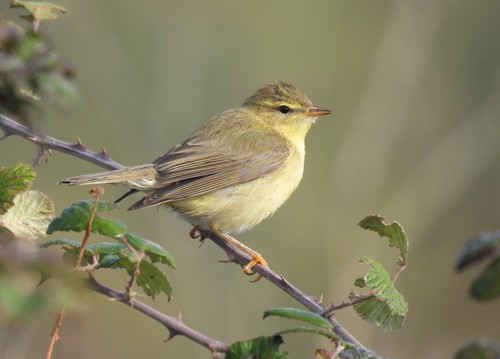
Willow Warbler
Phylloscopus trochilus
The Willow Warbler is a tiny marathon traveler that brings a cascading song to our gardens every spring. Weighing less than a AAA battery, this olive-green visitor is a master of aerial acrobatics and insect hunting.
Quick Identification
Size
Length: 11-12.5 cm (4.3-5 in); Wingspan: 17-22 cm (6.7-8.7 in); Weight: 7-15g (0.25-0.5 oz)
Colors
Olive-green to greenish-brown upperparts with pale yellow to off-white underparts. Features a distinct yellowish stripe above the eye (supercilium) and pale, pinkish-tan legs. Males and females look identical.
Key Features
- Prominent pale yellow 'eyebrow' stripe
- Pale pinkish or light brown legs
- Slightly longer wings compared to the Chiffchaff
- Constant active flitting through foliage
When You’ll See Them
Behavior
The Willow Warbler is a tireless bundle of energy, known for its constant movement as it flits through the canopy or scrub in search of food. Unlike some more sedentary garden birds, these warblers are almost always in motion, hovering briefly to snatch insects from the underside of leaves or making short, acrobatic aerial sallies. They are highly migratory, arriving in northern breeding grounds in early spring with a celebrated, melodic song that starts with a few high notes and cascades down into a delicate flourish.
Socially, they are mostly solitary during the breeding season, fiercely defending their territories through song. While they are not particularly shy of humans, their small size and preference for staying within the leaf canopy make them harder to spot than ground-feeding birds. They are most easily identified by their liquid, descending song, which is one of the most characteristic sounds of the European spring.
EverydayEarth exclusive
Camera Tips
To capture the Willow Warbler, your camera should be positioned at mid-height within the vegetation rather than on the ground. These birds rarely spend time on the floor, preferring the safety of shrubs and lower tree branches. Aim your camera at 'corridors' within garden hedges or near the outer branches of silver birch or willow trees, as these are their favorite foraging spots. A height of 4 to 6 feet is usually the sweet spot for catching them as they hop between branches.
Because Willow Warblers are incredibly fast and small, standard motion triggers can sometimes be too slow, resulting in 'empty' photos or blurry tails. If your AI camera has a 'high sensitivity' or 'fast trigger' mode, enable it. Setting your camera to take a short burst of photos (3-5 frames) or a 10-second video clip is much more effective than a single still image, as it increases the chances of catching the bird in a clear pose during its frantic foraging.
While they don't visit traditional seed feeders, you can lure them into camera range using a shallow, elevated bird bath. Willow Warblers are frequent bathers and are particularly attracted to the sound of moving water. Installing a small solar-powered fountain or 'wiggler' in your bird bath can be a magnet for them. Position the camera about 3 to 5 feet from the water source, ensuring the focus is sharp at that specific distance to capture the fine detail of their plumage and pale legs.
Lastly, timing is everything. In the northern hemisphere, the best window for recording them is during the 'spring fall' in April and May when they first arrive and are singing most vigorously. During this time, they are less cautious and more likely to be seen in the open. Late August and September also offer great opportunities as they become more active while fueling up for their long journey back to sub-Saharan Africa.
Similar Species
Species that look similar or are commonly confused with Willow Warbler.
Common Chiffchaff
The Chiffchaff has dark blackish legs and a simple 'chiff-chaff' song, whereas the Willow Warbler has pale legs and a melodic, descending song.
Wood Warbler
Brighter yellow throat and chest with a cleaner white belly, and prefers deeper woodland habitats.
Garden Warbler
Much plainer with almost no distinguishing facial markings or yellow tones, and a stouter build.
Frequently Asked Questions
Record Willow Warbler at your habitat
Connect a camera to start building your own species record — AI identifies every visitor automatically.