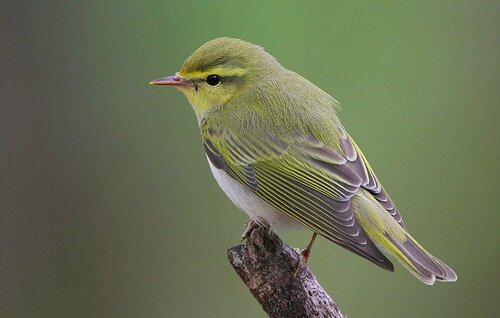
Wood Warbler
Phylloscopus sibilatrix
A vibrant lemon-and-lime songbird of the high canopy, the Wood Warbler is a master of the ancient forest. Watch for its unique 'shivering' trill and its surprising secret life as a ground-nesting explorer.
Quick Identification
Size
11-13 cm (4.3-5.1 in) long with a 19-24 cm (7.5-9.4 in) wingspan; weighs approx 7-12 g (0.25-0.42 oz)
Colors
Bright moss-green upperparts, vivid lemon-yellow throat and upper breast, and contrasting silky-white belly; males and females are identical in plumage.
Key Features
- Vibrant yellow throat and supercilium (eyebrow)
- Pure white underparts contrasting sharply with yellow chest
- Long wings reaching significantly down the tail
- Distinctive 'shivering' wing motion during song
When You’ll See Them
Behavior
The Wood Warbler is a restless and energetic songbird, almost entirely arboreal, spending most of its life high in the canopy of mature deciduous forests. It is famous for its unique 'shivering' display, where the male vibrates its wings and tail rapidly while delivering a metallic, accelerating trill that sounds like a spinning coin coming to rest on a marble table.
Unlike many other warbler species that flit through dense scrub, the Wood Warbler prefers 'open' woodland interiors with high leaf cover but little ground vegetation. Despite their preference for heights, they are strictly ground-nesters, tucking their dome-shaped nests into the leaf litter. They are highly migratory, traveling vast distances between European breeding grounds and tropical African wintering sites.
EverydayEarth exclusive
Camera Tips
Capturing the Wood Warbler on a backyard or trail camera is a rewarding challenge because they rarely visit traditional bird feeders. To find them, you must focus on their need for water and their ground-nesting habits. Place your camera near a shallow, natural-looking water feature or a stone bird bath located in a shaded, quiet corner of your yard. Wood Warblers are more likely to descend from the canopy for a bath if the area feels secluded and is sheltered by overhanging branches.
If your property borders mature woodland, try positioning your camera at a very low angle—about 10 to 15 inches off the ground—facing a patch of undisturbed leaf litter near the base of a large oak or beech tree. These birds build 'oven' nests on the ground, and while you should never disturb a nesting site, placing a camera on a likely foraging path nearby can capture rare footage of them searching for nesting materials or hunting for ground-dwelling insects in May and June.
Because these birds are small and move with lightning speed, use your camera’s highest PIR sensitivity setting and a fast trigger speed (0.2s or faster is ideal). Set your device to record short 10-15 second high-definition video clips rather than still photos. The Wood Warbler is often identified more easily by its shivering wing movements and its unique song than by a static image, which can easily be confused with other leaf warblers.
Lighting is crucial; Wood Warblers have a bright white belly that can easily 'blow out' and lose detail in direct sunlight. Aim your camera toward a north-facing or shaded spot where the natural forest light is filtered. This will help preserve the subtle contrast between their lemon-yellow throat and the snow-white underparts that are the hallmark of the species.
Similar Species
Species that look similar or are commonly confused with Wood Warbler.
Willow Warbler
The Wood Warbler has a much brighter yellow throat and a pure white belly, whereas the Willow Warbler is more uniformly dull yellow/olive below.
Common Chiffchaff
Chiffchaffs have dark legs and a duller plumage, lacking the vibrant lemon-yellow and clean white contrast of the Wood Warbler.
Western Bonelli's Warbler
Western Bonelli's lacks the bright yellow throat of the Wood Warbler, looking much 'cleaner' and greyer on the face and breast.
Frequently Asked Questions
Record Wood Warbler at your habitat
Connect a camera to start building your own species record — AI identifies every visitor automatically.