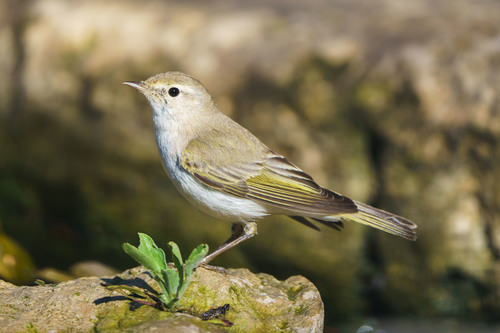
Western Bonelli's Warbler
Phylloscopus bonelli
A minimalist beauty of the Mediterranean woods, the Western Bonelli’s Warbler is best known for its bright white plumage and flashes of lemon-yellow. This tiny traveler brings a touch of elegance to any backyard it visits during its migratory journey.
Quick Identification
Size
11–12 cm (4.3–4.7 inches) in length; wingspan of 18–19 cm (7–7.5 inches); weight 7–9 grams (0.25–0.32 oz)
Colors
Greyish-green upperparts, bright yellowish-green rump and wing panels, and strikingly clean silvery-white underparts. No significant difference between males and females.
Key Features
- Bright yellowish-green rump that contrasts with a grey-brown back
- Unmarked, silky-white underparts from throat to vent
- Distinctive yellow 'panel' on the folded wing feathers
- Faint pale eyebrow stripe (supercilium) and dark eye-bead
When You’ll See Them
Behavior
During the breeding season, males are highly territorial and can be located by their distinctive, shivering trill, which sounds like a more musical version of a Wood Warbler. They are generally solitary birds outside of the nesting period, though they frequently join 'bird waves' or mixed-species foraging flocks during the autumn migration as they prepare for their long journey to sub-Saharan Africa. While they prefer the high canopy, they are known to descend to lower shrubs and garden water features during the heat of the day.
EverydayEarth exclusive
Camera Tips
Capturing the Western Bonelli’s Warbler on a backyard camera requires a focus on water. Because this species often inhabits dry, sun-drenched woodlands, a dripping birdbath or a shallow stone fountain acts like a magnet. Position your camera at eye-level with the water source, ideally 3 to 5 feet away. Use a fast trigger speed setting, as these birds are incredibly flighty and rarely stay still for more than a few seconds. If your camera has a 'burst' or 'pro-capture' mode, enable it to ensure you get a clear shot of the wings spread, which is the best way to see the diagnostic yellow rump.
Since they are canopy-dwellers, your best chance of seeing them at ground level is during the spring and autumn migration windows (late April and late August). During these times, place your camera near native shrubs like hawthorn or spindle, which harbor the small insects they crave. Avoid using seed or suet as bait; instead, focus on creating an insect-friendly environment with native plantings or even a small pile of decaying logs nearby to boost local bug populations.
For the best identification shots, try to angle your camera so the sun is behind the lens. This lighting highlights the subtle contrast between the grey back and the lemon-yellow wing panels. If you are using a trail camera in a more wooded area, mount it on a branch roughly 6 to 8 feet high, pointing toward a clear 'perch' branch that sits just outside a dense cluster of leaves. This is where the warbler is likely to pause before diving into the foliage to hunt.
Similar Species
Species that look similar or are commonly confused with Western Bonelli's Warbler.
Common Chiffchaff
Duller olive-brown overall with darker legs and lacks the bright yellow rump and clean white belly.
Willow Warbler
Has much more yellow/buff tones on the throat and breast, whereas the Bonelli's is pure white below.
Wood Warbler
Larger and much more vibrant yellow on the throat and face, with a more contrasting white belly.
Eastern Bonelli's Warbler
Visually nearly identical; best distinguished by its 'chip' call versus the Western's 'hoo-eet' and its more eastern European range.
Frequently Asked Questions
Record Western Bonelli's Warbler at your habitat
Connect a camera to start building your own species record — AI identifies every visitor automatically.