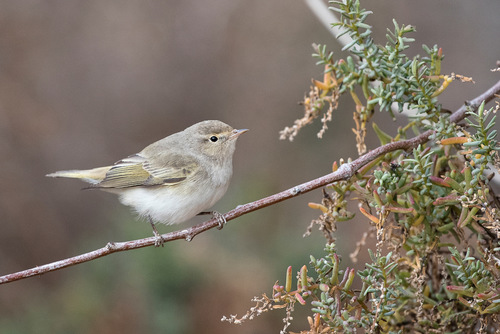
Eastern Bonelli's Warbler
Phylloscopus orientalis
A hidden gem of the Balkan woodlands, the Eastern Bonelli's Warbler is a master of the canopy. With its silky white plumage and bright yellow wing flashes, this tiny traveler brings a touch of Mediterranean charm to any backyard forest edge.
Quick Identification
Size
Length 11–12 cm (4.3–4.7 in); Wingspan 18–19 cm (7.1–7.5 in); Weight 7–9 g (0.25–0.32 oz)
Colors
Greyish-green upperparts, silky white underparts, and bright lemon-yellow patches on the wings and rump.
Key Features
- Bright lemon-yellow wing-panel and rump
- Silky white underparts with no yellow on the throat
- Grey-toned head and mantle
- Rapid, high-pitched monotonous trill song
When You’ll See Them
Geographic range
Where Does the Eastern Bonelli's Warbler Live?
This resilient traveler is native to Southeastern Europe and Asia Minor, with its primary breeding grounds stretching across the Balkan Peninsula, Greece, Bulgaria, and Turkey. As the seasons shift, the entire population migrates south to spend the winter in the dry savannas of Northeast Africa, particularly within Sudan, Ethiopia, and Chad. During migration, they are frequently spotted as passage visitors across the Middle East and the eastern Mediterranean coast.
Basemap © OpenStreetMap contributors
Behavior
The Eastern Bonelli's Warbler is a restless and energetic canopy dweller. It is rarely seen sitting still, preferring to flit constantly through the leaves of tall trees. Its foraging style is acrobatic; it frequently gleans insects from the undersides of leaves and is known to hover briefly or perform short aerial sallies to catch flying prey. Despite its small size, it is a hardy traveler, navigating vast distances during its annual migration across the Mediterranean Sea.
During the breeding season, males are highly territorial and use their distinctive, vibrating trill to mark their domain. While they are not particularly shy, their preference for high branches means they often go unnoticed by casual observers until they descend for water. They are generally solitary outside of the breeding season but may join loose, mixed-species flocks during migration to increase their chances of finding food and avoiding predators.
EverydayEarth exclusive
Camera Tips
To capture an Eastern Bonelli's Warbler on your backyard camera, focus your efforts on water. Because they prefer dry, often arid woodland habitats, a clean birdbath or a solar-powered water dripper acts as a powerful magnet. Place your camera at eye level with the water source, ideally about 1 to 2 meters away, to ensure the small bird fills enough of the frame for a clear ID.
These warblers move with incredible speed, so setting your camera to its fastest trigger interval is essential. Use a 'burst mode' for photos or high-frame-rate video (60fps or higher) to avoid ending up with a gallery of empty branches. If your AI camera has a 'Small Bird' or 'Warbler' detection mode, ensure it is active to prioritize these fast-moving subjects.
Lighting is your best friend for identifying this species. Position the camera so the sun is behind it, illuminating the bird's front. This helps highlight the stark contrast between the silky white belly and the subtle yellow wing-panels, which are the primary field marks. Avoid placing cameras in deep, mottled shade where the bird's grey-green back will blend perfectly into the leaves.
Finally, since the Eastern Bonelli's Warbler looks remarkably like its Western cousin and the Common Chiffchaff, try to use a camera that records high-quality audio. The Eastern's song—a fast, mechanical trill—is its most definitive characteristic. Recording just a few seconds of its song can provide 100% certainty for your sighting even if the visual is slightly blurry.
Similar Species
Species that look similar or are commonly confused with Eastern Bonelli's Warbler.
Western Bonelli's Warbler
Found in Western Europe; its song is a slower, more melodic trill compared to the Eastern's mechanical drone.
Common Chiffchaff
Lacks the bright yellow wing-panel and rump, and has much darker legs.
Wood Warbler
Larger with a much brighter yellow throat and breast that contrasts sharply with a pure white belly.
Frequently Asked Questions
Record Eastern Bonelli's Warbler at your habitat
Connect a camera to start building your own species record — AI identifies every visitor automatically.