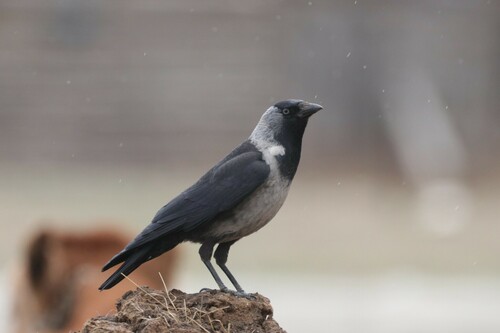
Daurian Jackdaw
Coloeus dauuricus
A social genius of the East Asian skies, the Daurian Jackdaw stands out with its unique 'panda-like' plumage and sharp intelligence. Whether wheeling in massive winter flocks or solving puzzles in a backyard, these corvids are a masterclass in avian adaptability.
Quick Identification
Size
Length: 28–32 cm (11–13 in); Wingspan: 60–68 cm (24–27 in); Weight: 170–200 g (6–7 oz)
Colors
Adult light morphs have a black head, throat, and wings contrasting with a creamy-white neck and belly. Dark morphs and juveniles are almost entirely black.
Key Features
- Distinctive creamy-white collar and underparts in light-morph adults
- Small, stubby black bill
- Dark iris that appears pale only at very close range
- Silvery-grey streaking on the ear coverts
When You’ll See Them
Geographic range
Where Does the Daurian Jackdaw Live?
Native to the vast landscapes of Eastern Asia, the Daurian Jackdaw finds its home across a broad belt spanning from the Transbaikal region of Russia and Mongolia into Central and Eastern China. During the colder months, these hardy birds often move southward, becoming common winter visitors in the Korean Peninsula and southern parts of Japan. As an adaptable species, they thrive wherever open foraging ground meets suitable nesting sites, such as hollow trees or old buildings.
Basemap © OpenStreetMap contributors
Behavior
The Daurian Jackdaw is a highly social and intelligent member of the corvid family, known for its gregarious nature. They are almost never seen alone, preferring the company of large flocks that can number in the hundreds, often mixing freely with Rooks or other crow species. Like their Western cousins, they are incredibly vocal, communicating with a variety of 'kyow' and 'jack' calls that help maintain flock cohesion during flight and foraging.
These birds are opportunistic and adaptable, frequently seen in urban environments and agricultural fields. They exhibit complex social hierarchies and are known for their monogamous pair bonds, which often last for life. In a backyard setting, they are cautious but curious, often observing from a high vantage point before descending to investigate a new food source. Their problem-solving abilities and playful behavior make them a fascinating subject for long-term observation.
EverydayEarth exclusive
Camera Tips
To capture the striking contrast of the Daurian Jackdaw’s plumage, place your camera in an open area with a clear line of sight to the sky. Because these birds are highly social, setting your camera to 'Burst Mode' or 'Photo + Video' is essential; you’ll often find that the first bird to land is merely a scout, with a dozen more following seconds later. Mounting the camera 4 to 6 feet off the ground on a fence post or a dedicated bird feeding station works best, as they prefer to land on elevated surfaces before hopping down to the ground to feed.
Jackdaws are attracted to high-energy treats. Using a platform feeder stocked with suet pellets, unsalted peanuts, or mixed grains will provide the best results. If you are using a trail camera, ensure the trigger speed is fast—under 0.5 seconds—as corvids are notoriously quick and twitchy. Position the camera with the sun at your back to prevent the white belly of the light morph from being washed out or the black head from becoming a featureless silhouette in high-contrast lighting.
Mid-morning is the prime time for activity as the flock moves from their roosting sites to foraging grounds. During the winter, they are much bolder and more likely to visit backyard setups. Consider a wide-angle lens setting if your camera allows, as this captures the chaotic and social 'crowd' behavior that defines the species. Avoid placing the camera too close to a high-traffic human area, as while they are urban-adapted, they remain more skittish than the common Large-billed Crow.
Similar Species
Species that look similar or are commonly confused with Daurian Jackdaw.
Frequently Asked Questions
Record Daurian Jackdaw at your habitat
Connect a camera to start building your own species record — AI identifies every visitor automatically.