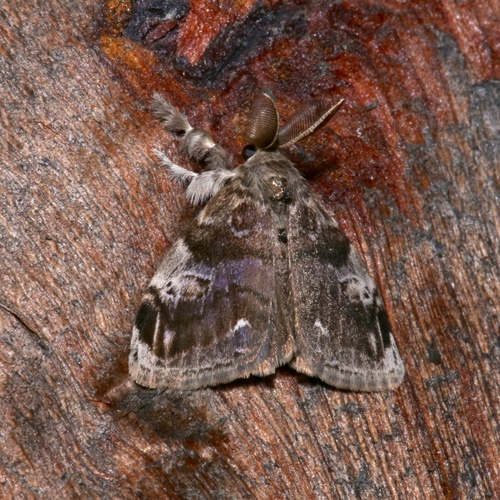
Definite Tussock Moth
Orgyia definita
With its iconic yellow 'tussocks' and unusual life cycle, the Definite Tussock Moth is a miniature masterpiece of the eastern American forest.
Quick Identification
Size
Adult males wingspan 25-30 mm (1-1.2 in); caterpillars grow to 30-35 mm (1.2-1.4 in); females are wingless.
Colors
Caterpillars are pale yellow or white with four dense yellow dorsal hair tufts and a yellow head. Adult males are mottled brownish-gray with a small white spot on the forewing.
Key Features
- Four dense yellow tufts of hair on the back of the caterpillar
- Bright yellow head and prothoracic shield on larvae
- Flightless, wingless females that remain on the cocoon
- Males have brownish-gray wings with a distinct white dot
When You’ll See Them
Geographic range
Where Does the Definite Tussock Moth Live?
This moth is a native resident of eastern North America, stretching from the northern reaches of Minnesota and New Brunswick down to the Gulf Coast. Its core range encompasses the eastern United States, particularly the Appalachian region and the Atlantic seaboard, extending as far south as South Carolina, Mississippi, and Louisiana. It thrives in temperate zones where broadleaf host trees are abundant.
Basemap © OpenStreetMap contributors
Behavior
The Definite Tussock Moth is most famous for its striking larval stage. Unlike many moths that hide during the day, these caterpillars are often seen boldly crawling on the trunks and leaves of deciduous trees. They are solitary feeders, rarely occurring in numbers large enough to cause significant damage to backyard trees, making them a welcome and fascinating visitor rather than a pest.
One of the most unusual aspects of their behavior involves the adult females. Because they are wingless, they never leave the silk cocoon from which they emerge. They release powerful pheromones to attract the winged males, mate on the spot, and lay their egg masses directly onto the old cocoon. This sedentary lifestyle makes them an excellent subject for stationary backyard cameras if you can spot the cocoons on tree bark.
EverydayEarth exclusive
Camera Tips
To capture the Definite Tussock Moth, you should focus your camera on the 'highways' of the insect world: the trunks of host trees like oaks, maples, or birches. Because the females are wingless and stay attached to their cocoons, placing a camera with a macro lens or a close-focus setting near a suspected cocoon site is the best way to record the unique mating behavior. Look for fuzzy, brownish silk patches tucked into bark crevices during late summer.
For the caterpillars, which are the most visually stunning stage, set your camera to trigger on movement along lower branches or garden fences near host trees. Since these larvae are active during both day and night, use a camera with a good flash or infrared capability to capture the bright yellow tufts against the dark bark at night. A height of 3 to 5 feet on a tree trunk is usually the 'sweet spot' for larval travel.
If you want to see the males, they are one of the few moth species where the males are often active during the day, patrolling for female pheromones. If you find a wingless female on a cocoon, keep your camera focused there; you are almost guaranteed to capture the erratic, zigzag flight of the males as they arrive to mate. Avoid using bright white lights at night, as they can disorient the males; instead, rely on motion-activated infrared triggers.
Similar Species
Species that look similar or are commonly confused with Definite Tussock Moth.
Frequently Asked Questions
Record Definite Tussock Moth at your habitat
Connect a camera to start building your own species record — AI identifies every visitor automatically.