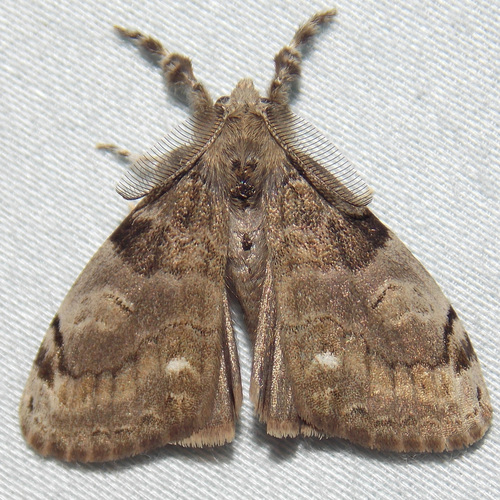
White-marked Tussock Moth
Orgyia leucostigma
The White-marked Tussock Moth is a backyard marvel with a caterpillar that looks like a high-fashion accessory. From its vibrant red head to its four fuzzy white tufts, this species is a favorite for nature photographers and curious gardeners alike.
Quick Identification
Size
Caterpillars reach 3.5 cm (1.4 in); adult male wingspan is 2.5–3.5 cm (1–1.4 in); females are wingless and roughly 1.5 cm (0.6 in) long.
Colors
Caterpillars feature a bright red head, yellow and black body stripes, and four white tufts; adult males are mottled gray-brown with a small white spot on each forewing.
Key Features
- Four dense, brush-like white tufts on the caterpillar's back
- Bright red head and two small red glands near the rear of the larva
- Adult males have a prominent white dot near the bottom edge of their gray-brown forewings
When You’ll See Them
Geographic range
Where Does the White-marked Tussock Moth Live?
Native to the North American continent, the White-marked Tussock Moth is a widespread inhabitant of the Eastern United States and Southern Canada. Its territory spans from the Atlantic coast westward to the Great Plains, with sightings common as far west as Texas and Alberta. It thrives in temperate regions where its diverse range of host deciduous trees provides ample food for the growing larvae.
Basemap © OpenStreetMap contributors
Behavior
The White-marked Tussock Moth is best known for its larval stage, characterized by a strikingly ornate caterpillar that appears in suburban backyards during the summer months. These caterpillars are solitary foragers but can occasionally experience localized population booms, leading to visible defoliation of garden trees. A unique aspect of this species' behavior is its dramatic sexual dimorphism: while males are standard-looking moths that fly in search of mates, the females are completely wingless and spend their entire adult lives clinging to the silk cocoons from which they emerged.
Interactions with humans are common, as the caterpillars often wander onto fences, porch railings, and garden furniture while searching for a place to pupate. While they are fascinating to observe, they should be treated with caution. The long, hair-like setae (bristles) on the caterpillar's body are defensive; they can break off in human skin and cause allergic reactions or painful rashes. In the ecosystem, they serve as a vital food source for various birds and predatory insects, despite their stinging hairs.
EverydayEarth exclusive
Camera Tips
Capturing the White-marked Tussock Moth on an AI-powered camera requires focusing on the caterpillar stage, as the wingless females and nondescript males are much harder to spot. For the best results, mount your camera using a macro lens or a close-focus setting on the trunks of host trees like Maples or Oaks at chest height. Position the camera to look along the length of a branch or directly at a vertical patch of bark where caterpillars frequently travel between feeding sites and resting spots.
During the late summer (July through September), look for the cocoons, which are often spun in crevices of bark or under the eaves of houses. Since the female moth stays on her cocoon after emerging, you can set up a time-lapse to witness the entire reproductive cycle—from her emergence and the male's arrival to the laying of the frothy white egg mass. Lighting is key for this species; if your camera has a built-in ring light or if you can provide soft side-lighting, it will highlight the translucent 'tussocks' and long black hair pencils that make the larva so distinct.
To attract adult males for a nighttime recording, a standard UV light or 'blacklight' trap positioned near your camera will be highly effective. The males are strong fliers and are easily drawn to light sources during their peak flight window in mid-to-late summer. For the larvae, no bait is necessary other than the presence of their favorite host plants; simply keep the camera focused on areas with fresh leaf damage, as the caterpillars will likely be nearby, continuing their feast.
Similar Species
Species that look similar or are commonly confused with White-marked Tussock Moth.
Frequently Asked Questions
Record White-marked Tussock Moth at your habitat
Connect a camera to start building your own species record — AI identifies every visitor automatically.