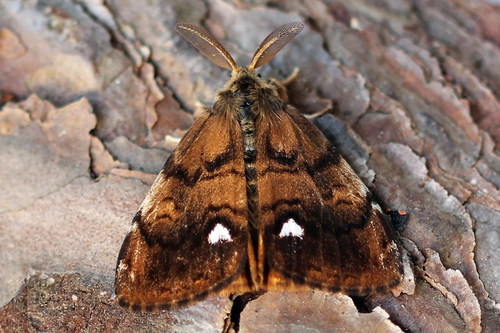
Rusty Tussock Moth
Orgyia antiqua
A master of transformation and unusual habits, the Rusty Tussock Moth features day-flying males and flightless females. Its vibrant caterpillars and unique life cycle make it a fascinating find for any backyard naturalist.
Quick Identification
Size
Males have a wingspan of 25-35 mm (1-1.4 in); females are wingless and grow to 12-15 mm (0.5-0.6 in) in length.
Colors
Males are rusty-brown with a distinct white comma-shaped spot on each forewing; females are a uniform mouse-grey and lack wings.
Key Features
- Male: Rusty-orange wings with a prominent white spot near the lower corner
- Female: Wingless, stout body resembling a grey grub
- Larva: Four dense yellow 'tussock' tufts on the back and long black hair pencils at the head and rear
When You’ll See Them
Geographic range
Where Does the Rusty Tussock Moth Live?
Native to the temperate regions of Europe and Northern Asia, the Rusty Tussock Moth has successfully expanded its territory across the Atlantic. It is now widely established throughout North America, ranging from southern Canada across the northern and central United States. Because of its adaptability to human-altered landscapes, it is one of the most common 'backyard' moths found across the Holarctic region.
Basemap © OpenStreetMap contributors
Behavior
The Rusty Tussock Moth, also known as the Vapourer, exhibits some of the most unusual behavior in the moth world. Unlike most moths that are nocturnal, the males are active during the day, flying with a fast, erratic, zig-zagging motion in search of females. They are often seen fluttering around the canopy of trees or garden shrubs during mid-summer afternoons.
The females are entirely flightless, possessing only tiny vestigial wing stubs. Upon emerging from her cocoon, the female remains stationary, often sitting directly on top of the silken case she just exited. She releases powerful pheromones to attract the wandering males. Once mated, she lays her eggs in a neat mass directly onto the old cocoon and dies shortly after, never having moved more than a few inches from where she pupated.
EverydayEarth exclusive
Camera Tips
Capturing the Rusty Tussock Moth requires a different strategy than typical moth-trapping because the males are diurnal. To photograph the males, place your camera near known host plants like hawthorn or willow during sunny afternoons between July and September. Use a high shutter speed or a 'burst' mode, as their flight is incredibly erratic and fast. Setting your camera to a wide-angle macro view can help capture them as they hover near foliage.
For a guaranteed 'stationary' subject, look for the cocoons on fences, tree trunks, or the undersides of garden walls. If you spot a wingless female, you can set up a time-lapse. Since she does not move, you can capture the entire sequence of a male arriving to mate and the subsequent egg-laying process. Ensure your camera is mounted on a stable tripod at a distance of 12-18 inches with the focus locked on the cocoon.
If you are using AI-powered cameras that trigger on movement, place them near flowering shrubs in the late morning. While the moths don't feed as adults, males are often seen 'patrolling' these areas. During the larval stage in late spring, you can easily capture the spectacular, multi-colored caterpillars. Mount cameras low to the ground or level with lower tree branches where the larvae are most active during the day.
Similar Species
Species that look similar or are commonly confused with Rusty Tussock Moth.
Frequently Asked Questions
Record Rusty Tussock Moth at your habitat
Connect a camera to start building your own species record — AI identifies every visitor automatically.