Demoiselle Crane
Grus virgo
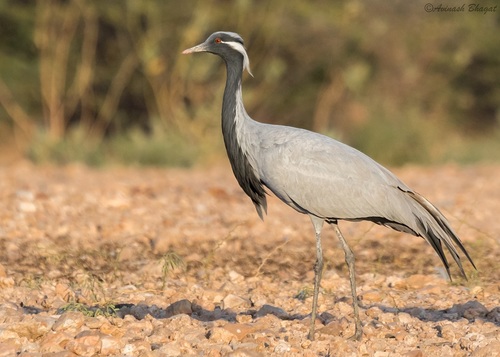
The Demoiselle Crane is the smallest and most elegant member of the crane family, known for its breathtaking migration over the Himalayas. With its striking white ear plumes and rhythmic dancing, it has become a symbol of grace and endurance across Eurasia.
Quick Identification
Size
Length 85–100 cm (33–39 in); wingspan 155–180 cm (61–71 in); weight 2–3 kg (4.4–6.6 lb)
Colors
Pale bluish-grey plumage overall; black face, throat, and long neck plumes; conspicuous white ear tufts extending from the eye to the back of the head; dark red or orange eyes.
Key Features
- Smallest crane species in the world
- Distinctive white feathery plumes behind the eyes
- Long black feathers hanging from the lower neck
- Straight, pointed bill used for foraging in dry soil
When You’ll See Them
Geographic range
Where Does the Demoiselle Crane Live?
Native to the temperate grasslands of Central Eurasia, the Demoiselle Crane's breeding range stretches from the Black Sea across Kazakhstan and Mongolia into Northeast China. These birds are highly migratory; western populations travel to sub-Saharan Africa for the winter, while the larger eastern populations cross the highest peaks of the Himalayas to reach the Indian subcontinent. A small, isolated breeding population also exists in eastern Turkey.
Basemap © OpenStreetMap contributors
Behavior
Demoiselle Cranes are highly social birds, often seen in large, noisy flocks that can number in the thousands, especially during their spectacular migrations. They are famous for their intricate 'dancing' displays, which include leaping, bowing, and running with wings outstretched. Unlike some other cranes that dance primarily during courtship, Demoiselles use these movements to strengthen social bonds and reduce aggression within the flock.
These birds are legendary for their physical endurance, particularly the populations that migrate over the Hindu Kush and Himalayan mountains to reach their wintering grounds in India. They fly at altitudes of up to 26,000 feet, navigating treacherous winds and avoiding predators like golden eagles. In regions like Khichan, Rajasthan, they have developed a unique relationship with humans, where villagers provide tons of grain daily to thousands of wintering 'Koonj'.
EverydayEarth exclusive
Camera Tips
When setting up an AI-powered camera for Demoiselle Cranes, focus on wide-open spaces. These birds are extremely wary of predators and prefer to forage or rest in areas with 360-degree visibility. If you live near an agricultural edge or a steppe-like environment where they are known to frequent, place your camera on a low tripod or a sturdy stake about 2 feet off the ground. Angle the lens slightly upward to capture their full height and those iconic white ear tufts.
Watering holes are the most reliable spots for trail camera placement. Demoiselle Cranes often congregate at the edges of shallow ponds or rivers at dawn and dusk. Because they are social, a wide-angle lens is preferable to capture the interaction between multiple birds. Set your camera to a 'burst' or 'multi-shot' mode with a fast shutter speed; their movements, especially during their sporadic dancing bouts, are lightning-fast and can easily result in motion blur on slower sensors.
While we don't recommend baiting wild cranes, if you are in a region like rural India where they are accustomed to 'chabutaras' (feeding stations), position your camera near the perimeter of the feeding area. Use the early morning light to your advantage; the low sun highlights the subtle grey-blue tones of their feathers against the black of their necks. Ensure your camera is well-camouflaged with local grasses or burlap, as their keen eyesight can easily spot unnatural objects in their environment.
Similar Species
Species that look similar or are commonly confused with Demoiselle Crane.
Frequently Asked Questions
Record Demoiselle Crane at your habitat
Connect a camera to start building your own species record — AI identifies every visitor automatically.