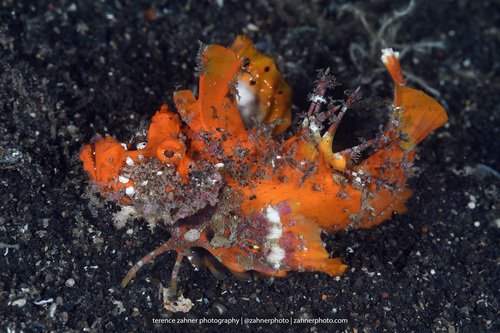
Devil Stinger
Inimicus didactylus
A master of mimicry and a venomous marvel, the Devil Stinger 'walks' across the ocean floor on specialized fins. This nocturnal goblin of the sea is the ultimate ambush predator, blending perfectly with the shifting sands of the Western Pacific.
Quick Identification
Size
Typically reaches up to 25 cm (10 inches) in length, with a stocky, heavy-set body.
Colors
Highly variable camouflage including sandy yellow, dull red, and brownish-gray; the inner surface of the pectoral fins features bright yellow and black warning patterns.
Key Features
- Two detached lower pectoral fin rays used for 'walking'
- Venomous dorsal spines with deep grooves
- Warty, knobby skin texture often covered in algae or silt
- Bulging eyes located on high bony ridges
When You’ll See Them
Geographic range
Where Does the Devil Stinger Live?
The Devil Stinger is native to the tropical waters of the Western Pacific Ocean. Its core range extends through the coastal waters of Southeast Asia, including Thailand, Indonesia, the Philippines, and Malaysia, stretching northward toward southern China and southern Japan. It is also frequently found in the shallow coastal regions of Northern Australia and Papua New Guinea.
Basemap © OpenStreetMap contributors
Behavior
The Devil Stinger is a master of patient ambush. Much of its day is spent partially buried in the sandy or muddy seabed, using its specialized pectoral fins to excavate a shallow depression. It relies on its incredible camouflage to remain invisible to both predators and the small fish and crustaceans it hunts. When threatened, it doesn't swim away immediately; instead, it flares its pectoral fins to reveal bright 'warning' colors on the underside to startle the intruder.
Perhaps its most fascinating behavior is its method of locomotion. Instead of swimming through the water column like most fish, the Devil Stinger uses two modified rays on its pectoral fins as 'legs' to crawl slowly along the ocean floor. This 'walking' motion allows it to move stealthily without creating the vibrations or pressure waves that swimming would cause, making it a ghost-like presence in its habitat.
EverydayEarth exclusive
Camera Tips
Capturing the Devil Stinger on camera requires specialized underwater equipment, as this species rarely ventures into water shallower than a few inches. For backyard coastal observers or reef enthusiasts, a waterproof trail camera or a stationary action camera in a dive housing is essential. Place the camera on a weighted base or a low-profile tripod directly on the sandy seabed. The Devil Stinger lives a bottom-dwelling life, so the lens should be no more than 5 to 10 centimeters off the substrate, angled slightly upward to capture its profile and eyes.
Since these fish are primarily nocturnal and rely on burying themselves during the day, nighttime recording is your best bet for seeing movement. Use a camera with high-quality infrared (IR) capabilities or, better yet, a dim, constant external underwater light to avoid scaring the fish while providing enough illumination for color capture. If using white light, a red filter can sometimes help in observing their natural behavior without the fish becoming defensive. Because they move very slowly, set your camera to take longer video clips (30-60 seconds) rather than quick bursts.
Timing is critical when setting your camera near tide pools or reef flats. The Devil Stinger is most active during the rising tide at night, when the water brings in fresh nutrients and prey. Look for 'muck' environments—areas with fine sand or silt near reef structures—as these are their preferred hunting grounds. Avoid areas with heavy surge or wave action, as the resulting silt kick-up will obscure your footage. If you find a spot with small depressions in the sand, there may be a Stinger nearby; they often return to the same general hunting territory nightly.
Similar Species
Species that look similar or are commonly confused with Devil Stinger.
Frequently Asked Questions
Record Devil Stinger at your habitat
Connect a camera to start building your own species record — AI identifies every visitor automatically.