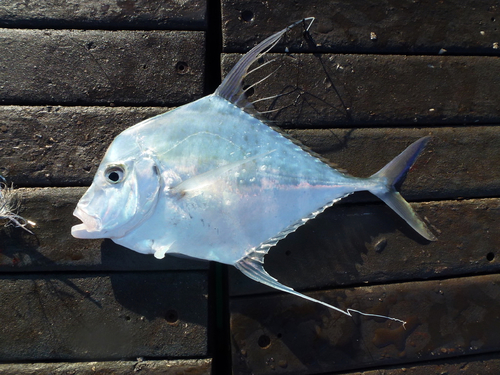
Diamond Trevally
Scyris indica
A shimmering jewel of the Indo-Pacific, the Diamond Trevally captivates with its mirror-like skin and majestic, trailing fins. Whether patrolling deep reefs or hiding in coastal seagrass, this powerful predator is a masterpiece of marine evolution.
Quick Identification
Size
Grows up to 165 cm (65 inches) in length and can weigh up to 25 kg (55 lbs).
Colors
Brilliant silvery or mirror-like body; juveniles feature dark, trailing fin filaments that fade with age.
Key Features
- Deeply compressed, diamond-shaped body
- Extremely long, thread-like dorsal and anal fin filaments in juveniles
- Mirror-like reflective skin with a slight metallic blue-green tint on the back
- Pronounced steep head profile with a slight concavity near the eyes
When You’ll See Them
Geographic range
Where Does the Diamond Trevally Live?
The Diamond Trevally is native to the tropical and subtropical waters of the Indo-West Pacific region. Its expansive range begins along the eastern coast of Africa and the Red Sea, stretching across the Indian Ocean to India, Southeast Asia, and the Indonesian archipelago. It is a common sight in the waters of northern Australia and extends as far north as southern Japan and the Pacific Islands.
Basemap © OpenStreetMap contributors
Behavior
The Diamond Trevally is a fast-moving, predatory fish known for its striking physical transformation as it matures. Juveniles are solitary and favor protected environments like estuaries and seagrass beds, where their long, trailing fin filaments provide camouflage by mimicking the stinging tentacles of jellyfish. This clever mimicry helps protect the vulnerable young fish from larger predators while they hunt for small crustaceans.
As they transition into adulthood, Diamond Trevallys lose these long filaments and move into deeper coastal waters and coral reefs. While they can be found in small schools, larger adults are frequently seen cruising solo or in pairs along reef drop-offs. They are powerful swimmers, capable of sudden bursts of speed to intercept prey or escape danger.
For humans, they are a prized catch for recreational anglers due to their strength and endurance. While they are generally wary of divers, their shimmering bodies make them a spectacular sight in clear water, often reflecting sunlight like a moving mirror under the waves.
EverydayEarth exclusive
Camera Tips
To capture the Diamond Trevally on an AI-powered camera, you will need a waterproof housing or a dedicated underwater camera system. Because these fish are highly reflective, positioning your camera to catch the 'golden hour' light (early morning or late afternoon) can create stunning visuals as the sun glints off their mirror-like scales. Avoid placing the camera directly facing the sun to prevent lens flare from the fish's reflective body.
For those living near estuaries or coastal docks, mounting a camera to a pier piling at a depth of 1 to 3 meters is an excellent strategy for spotting juveniles. Using a mesh bait bag filled with crushed oily fish or shrimp can lure them into the camera's field of view. Ensure the camera is set to a high frame rate, as Trevallys are known for their rapid, darting movements that can blur on slower settings.
In reef environments, look for 'cleaning stations' where smaller fish pick parasites off larger species; Diamond Trevallys often frequent these spots. Setting your camera to trigger on motion with a wide-angle lens is best, as it allows you to capture the full diamond-shaped silhouette of the fish as it passes by. Check your housing for salt buildup regularly, as crystalized salt can ruin the clarity of your shots.
Similar Species
Species that look similar or are commonly confused with Diamond Trevally.
African Pompano
Very similar in appearance, but has a more steeply curved, rounded head profile compared to the Diamond Trevally's slight indentation.
Golden Trevally
Lacks the long fin filaments and features a distinct gold-yellow tint with dark vertical bars, especially when young.
Giant Trevally
Much larger and more robust with a blunt head and silvery-grey to black coloration, lacking the mirror-like finish of the Diamond Trevally.
Frequently Asked Questions
Record Diamond Trevally at your habitat
Connect a camera to start building your own species record — AI identifies every visitor automatically.