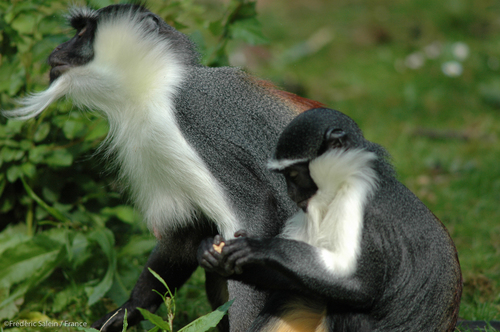
Diana Monkey
Cercopithecus diana
Named after the Roman goddess of the hunt for its bow-shaped white brow, the Diana monkey is a crown jewel of the West African canopy. Strikingly colored and highly vocal, this endangered primate is a master of the treetops.
Quick Identification
Size
Head-body length 40–55 cm (16–22 in); Tail length 50–75 cm (20–30 in); Weight 2.2–7 kg (5–15 lbs)
Colors
Black and dark grey body with a striking white throat, chest, and ruff; white crescent-shaped brow; chestnut or orange patch on the lower back and inner thighs.
Key Features
- Distinctive white crescent-shaped brow band
- Long white beard and throat ruff
- Contrast of dark fur with chestnut-colored inner thighs
- Exceptionally long, slender black tail
When You’ll See Them
Geographic range
Where Does the Diana Monkey Live?
The Diana monkey is a specialist of the Upper Guinean forests in West Africa. Its native range is concentrated in the high-canopy rainforests of Sierra Leone, Liberia, and the western portions of Côte d'Ivoire. This species is a true forest resident and is almost never found in savanna or heavily degraded habitats, making it a key indicator of forest health in its native region.
Basemap © OpenStreetMap contributors
Behavior
These monkeys are particularly famous for their complex vocal communication system. They use a wide array of distinct alarm calls to warn the troop about specific threats; for instance, they have one specific call for leopards and another for crowned eagles. Interestingly, other forest animals, such as hornbills and other monkey species, have learned to recognize and react to these specific Diana monkey warnings. Socially, they spend a great deal of time grooming one another, which helps maintain group cohesion and reduce stress within the troop.
EverydayEarth exclusive
Camera Tips
Angle your camera to look slightly across a branch rather than straight down on it. This perspective captures the striking white 'Diana' brow and the distinctive chestnut patches on their thighs, which are essential for identification. Because the rainforest canopy can be quite dark even at midday, use a camera with a high-quality sensor and fast trigger speeds. Diana monkeys are incredibly agile and often leap between branches; a slow shutter speed will result in a grey-and-white blur rather than a clear image.
Timing is everything with this species. They are most active in the early morning hours just after sunrise as they move from their sleeping trees to feeding sites. Positioning your camera near a wild fig tree (Ficus) or an African oak during its fruiting season is the best way to guarantee sightings. Avoid using any lures or baits; instead, rely on the natural rhythms of the forest and the monkeys' preference for reliable, mature fruit sources. Lastly, ensure your camera housing is extremely weather-resistant, as the humid, rainy environment of the Upper Guinean forest can quickly damage electronics.
Similar Species
Species that look similar or are commonly confused with Diana Monkey.
Frequently Asked Questions
Record Diana Monkey at your habitat
Connect a camera to start building your own species record — AI identifies every visitor automatically.