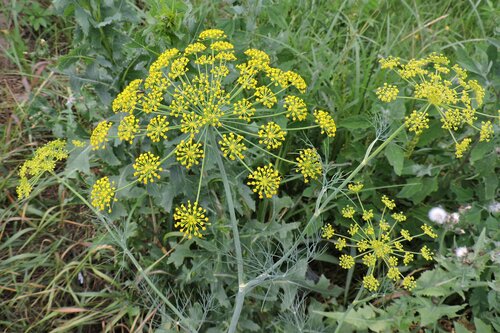
Dill
Anethum graveolens
A fragrant staple of the spice rack that doubles as a vital sanctuary for the garden's most beautiful butterflies. Dill is a master of multitasking, providing both a nursery for caterpillars and a nectar-rich buffet for pollinators.
Quick Identification
Size
40–60 cm (16–24 in) in height, with some stalks reaching up to 1 m (3.3 ft); spread of 30–40 cm (12–16 in).
Colors
Bright green to blue-green feathery foliage; tiny, vibrant yellow flowers clustered in flat-topped umbels.
Key Features
- Delicate, thread-like feathery foliage
- Hollow, ribbed green stems
- Umbrella-shaped yellow flower clusters (umbels)
- Pungent, sweet, and aromatic scent
- Flat, oval brown seeds with light-colored ridges
When You’ll See Them
Geographic range
Where Does the Dill Live?
Native to the Mediterranean region, North Africa, and Western Asia, Dill has expanded its presence to become a common sight across nearly every temperate region of the globe. It is now widely naturalized throughout Europe and North America, frequently seen in backyard herb gardens and occasionally escaping into the wild along roadsides or field edges. In the United States and Canada, it thrives as a hardy annual in zones 3 through 11, appearing wherever humans have cultivated the land.
Basemap © OpenStreetMap contributors
Behavior
Dill is a fast-growing annual herb that follows a distinct lifecycle driven by temperature and light. It begins as a low-growing rosette of feathery leaves before quickly "bolting"—sending up tall, hollow stalks to produce flowers as the heat of summer intensifies. This transition from foliage to flower is essential for the backyard ecosystem, as it shifts the plant's role from a food source for larvae to a nectar station for adult pollinators.
As a key member of the Apiaceae family, dill exhibits a fascinating symbiotic relationship with local wildlife. It is a primary host plant for Swallowtail butterflies, which are chemically attracted to the plant's essential oils. Beyond being a nursery for caterpillars, the broad, flat landing pads of its yellow flowers (umbels) are perfectly designed for short-tongued beneficial insects like hoverflies and predatory wasps, which provide natural pest control for the rest of the garden.
EverydayEarth exclusive
Camera Tips
Capturing the secret life of Dill requires a camera with a short minimum focus distance or a dedicated macro lens. Because the most interesting visitors—like the Black Swallowtail caterpillar—are small and slow-moving, mount your camera on a sturdy stake or low tripod approximately 12 to 18 inches from the foliage. For the best results, position the camera to face the morning sun (east-facing) to catch the light illuminating the translucent green leaves and the dew clinging to the fine needles.
Dill stems are notably hollow and flexible, meaning they sway significantly in even a light breeze. To prevent hundreds of "false triggers" caused by moving plants, use a garden stake to gently tether the main stalk of the Dill plant you are monitoring. This stabilizes the subject within your frame without harming the plant. If your camera has AI-detection, set it to the "Insect" or "Pet/Small Animal" mode to prioritize the movement of caterpillars or visiting butterflies over the background motion.
For the blooming phase, focus your camera on the top of the yellow umbels. This is where you will catch the high-speed action of predatory wasps and hoverflies. Set your shutter speed to at least 1/500th of a second if the light allows, or use a high-frame-rate video mode (60fps or higher) to capture the intricate wing movements of these pollinators. If you are monitoring the growth of caterpillars, consider using a time-lapse setting that takes one photo every 15 minutes during daylight hours to document their rapid consumption of the foliage.
Similar Species
Species that look similar or are commonly confused with Dill.
Fennel
Fennel is a taller perennial with a thick bulbous base and a distinct licorice scent, unlike the annual dill's spicy-sweet aroma.
Wild Carrot
Also known as Queen Anne's Lace, it features white flower clusters often with a single dark red floret in the center, rather than Dill's yellow flowers.
Frequently Asked Questions
Record Dill at your habitat
Connect a camera to start building your own species record — AI identifies every visitor automatically.