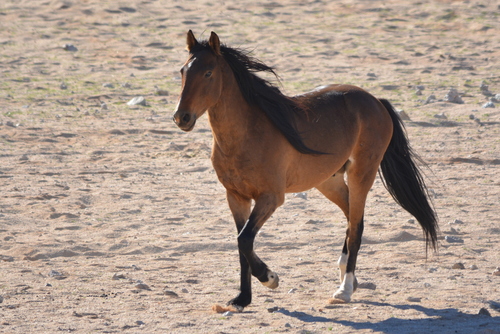
Domestic Horse
Equus caballus
The domestic horse is a powerful symbol of grace and history that has been a human companion for over 5,000 years. From rugged mountain trails to suburban paddocks, these intelligent animals continue to captivate us with their strength and social complexity.
Quick Identification
Size
142–163 cm (14–16 hands) at the shoulder; 380–1,000 kg (840–2,200 lbs) depending on breed
Colors
Extremely varied including bay, chestnut, black, grey, pinto, and palomino; markings include white blazes and socks
Key Features
- Single solid hoof on each limb
- Long, flowing mane and tail
- Large, expressive eyes on the sides of the head
- Muscular neck and powerful hindquarters
When You’ll See Them
Sightings on EverydayEarth
May 26, 2026
A horse stands directly in front of the camera, with the back of its head and its large ear partially obscuring the view on the left. In the background, a group of flying foxes are visible hanging from the mesh ceiling and a rope inside a large enclosure.
Geographic range
Where Does the Domestic Horse Live?
Originally native to the vast open steppes of Central Asia and Eastern Europe, the domestic horse has been transported by humans to every corner of the globe. Today, they are found on every continent except Antarctica, with the highest population densities concentrated in North America, South America, and Asia. While primarily kept as livestock or companions, significant feral populations, such as the Mustangs of the United States and the Brumbies of Australia, have established themselves in rugged wildlands worldwide.
Basemap © OpenStreetMap contributors
Behavior
As prey animals, horses have a finely tuned 'flight or fight' response, usually opting for speed and distance when startled. Despite their size, they are remarkably sensitive and capable of forming deep emotional bonds with humans. Their intelligence allows them to learn complex tasks, making them versatile partners in everything from ranch work to professional sport.
EverydayEarth exclusive
Camera Tips
Capturing the majesty of a horse on a trail camera requires careful consideration of their size and curiosity. You should mount your camera at roughly chest height—about 3.5 to 4 feet—to ensure you catch their full profile rather than just their legs or the top of their back. Use a heavy-duty mount or secure the camera to a very sturdy post, as horses are notorious for using trail cameras as scratching posts, which can quickly knock your lens out of alignment or damage the housing.
For the best results, position your camera near communal areas like water troughs, mineral blocks, or well-used gates. Because horses are most active during the 'crepuscular' hours of dawn and dusk, orient your camera to avoid direct east-west sunlight which can wash out your images. If you are monitoring a large pasture, a camera with a wide-angle lens and a fast trigger speed is essential for capturing the movement of the herd as they graze past.
Horses are large enough that you can usually turn down the PIR (motion sensor) sensitivity to 'low' or 'medium' to prevent the camera from being triggered by every blade of grass blowing in the wind. Setting your camera to take a 'burst' of 3 to 5 photos per trigger is highly recommended. This will allow you to see the nuances of their behavior, such as ear positioning or social grooming, which provides a much deeper look into their personality. At night, be aware that their large eyes will highly reflect infrared light, so try to angle the camera so it is not pointing directly at their face as they approach.
Similar Species
Species that look similar or are commonly confused with Domestic Horse.
Frequently Asked Questions
Record Domestic Horse at your habitat
Connect a camera to start building your own species record — AI identifies every visitor automatically.