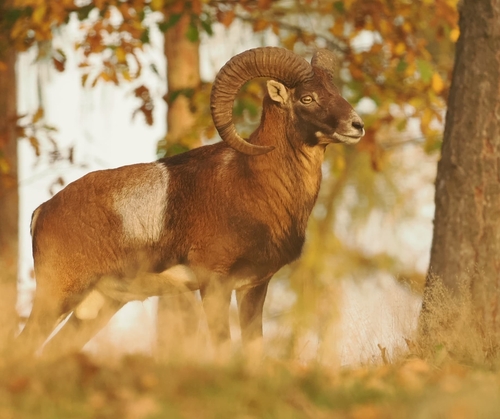
Domestic Sheep
Ovis aries
The world's most famous woolly grazer, the domestic sheep is a masterpiece of social intelligence and hardiness. From vast mountain ranges to backyard paddocks, these gentle ruminants offer a fascinating glimpse into the history of agriculture.
Quick Identification
Size
1.2–1.8 m (3.9–5.9 ft) in length; weight ranges from 45–160 kg (100–350 lbs) depending on breed
Colors
Varied by breed; includes solid white, cream, dark brown, black, and piebald (spotted) patterns
Key Features
- Thick woolly fleece or coarse hair
- Horizontal rectangular pupils for wide-angle vision
- Divided upper lip (philtrum) for precise grazing
- Downward-hanging tail (unless docked)
When You’ll See Them
Sightings on EverydayEarth
Jul 11, 2026
A group of five White Rhinoceros are feeding on a patch of hay in a clearing. A lone domestic sheep is standing directly among them, also grazing. In the lower-left foreground, a Vervet Monkey sits quietly on the ground, watching the larger animals.
Jul 6, 2026
In the darkness of night, a single domestic sheep stands motionless in an open area, facing away from the camera toward the surrounding woodland.
Jul 5, 2026
A group of at least four white rhinoceroses are resting and feeding in a fenced enclosure. Several white domestic sheep move actively among them, grazing on the ground near the larger animals. The low angle of the sun casts long shadows across the dusty clearing.
Jul 4, 2026
A domestic sheep stands in a clearing during a nighttime rain shower. It remains mostly stationary, turning its head to look around while another sheep is partially visible behind a tree in the background.
Jul 3, 2026
A group of white rhinoceroses are seen resting peacefully on the ground at night. In the center foreground, a domestic sheep is also lying down, its head and ears occasionally twitching as it rests alongside the much larger mammals.
Jul 3, 2026
A domestic sheep is seen standing on the right side of the yard at night. After a few moments of looking around, it begins to walk steadily across the open ground toward the left side of the frame.
Geographic range
Where Does the Domestic Sheep Live?
Originally descended from the wild mouflon of Southwest Asia and Europe, domestic sheep have been introduced by humans to every continent except Antarctica. They are most densely concentrated in major agricultural nations like China, Australia, India, and the United Kingdom, where vast grasslands support large-scale flocks. In North America and New Zealand, they are a common sight in both industrial farming regions and smaller, suburban 'hobby' farms.
Basemap © OpenStreetMap contributors
Behavior
Domestic sheep are highly social ruminants that rely on a powerful flocking instinct for safety and social structure. They are remarkably intelligent, capable of recognizing the faces of dozens of other sheep and humans for years at a time. In a group setting, they typically follow a leader—often an older ewe—and move in a coordinated fashion while grazing. Their day is strictly divided between active foraging and long periods of rest.
As ruminants, sheep spend several hours a day 'chewing the cud,' a process where they regurgitate partially digested food to break it down further. While often perceived as timid, they are incredibly hardy and adaptable to various climates. Their interactions with humans are deeply rooted in history, making most breeds docile and easily managed, though they remain sensitive to sudden movements and high-pitched sounds.
EverydayEarth exclusive
Camera Tips
To capture the best footage of domestic sheep, camera placement should be at their eye level, roughly 2 to 3 feet off the ground. This height allows you to see their unique horizontal pupils and expressive facial movements. Focus your camera on high-traffic areas such as water troughs, mineral lick blocks, or the gates where they congregate when waiting for a handler. These 'bottleneck' locations ensure the sheep remain in the frame long enough for the AI to trigger and record.
Sheep are most active during the cooler hours of the early morning and late afternoon. During the midday heat, they often seek out shade under large trees or along the north side of buildings to rest and chew their cud; placing a camera in these shaded rest areas can provide excellent 'relaxed' behavior shots. To attract them specifically to a spot for your camera, a fresh flake of alfalfa hay or a salt block is highly effective. However, ensure the camera is mounted securely to a sturdy post or tree, as sheep are curious and may rub against the equipment or nudge it with their muzzles.
If you are looking for more dynamic action, the spring lambing season is the ideal time. Set your camera near 'nursery' areas—sheltered corners of a field where ewes and lambs gather. Use a burst photo mode or high-frame-rate video to capture 'stotting,' the stiff-legged jumping behavior lambs exhibit when playing. For the best lighting, aim the camera so the sun is behind it, as the thick texture of wool can cause harsh shadows or look 'blown out' in direct, midday sunlight.
Similar Species
Species that look similar or are commonly confused with Domestic Sheep.
Frequently Asked Questions
Record Domestic Sheep at your habitat
Connect a camera to start building your own species record — AI identifies every visitor automatically.