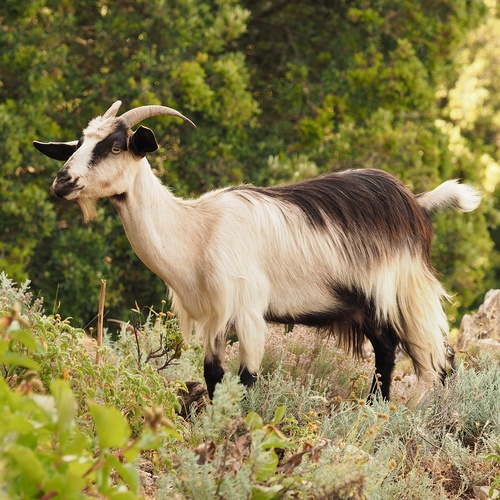
Domestic Goat
Capra hircus
Curious, agile, and full of personality, the domestic goat is the ultimate backyard browser. Whether they're clearing brush or performing acrobatic leaps, these intelligent mammals are a joy to observe on camera.
Quick Identification
Size
Height 41-110 cm (16-43 in) at shoulder; Weight 20-140 kg (44-310 lbs) depending on breed
Colors
Extremely varied including solid white, black, brown, or red; often multi-colored with spots, 'badger' facial stripes, or 'Swiss' markings (pale legs and ears)
Key Features
- Horizontal rectangular pupils
- Short tail that points upward
- Backwards-curving horns or naturally 'polled' (hornless)
- Cloven hooves designed for climbing
When You’ll See Them
Sightings on EverydayEarth
Jul 11, 2026
Several white rhinoceroses are resting closely together on the ground in a cluster. A domestic goat stands alert nearby in the foreground, likely acting as a companion animal for the rhinos in this enclosure.
Jul 7, 2026
A group of four white rhinoceros are lying down and resting under the canopy of several trees during the night. To their right, two domestic goats are also settled on the ground, appearing calm and stationary. The animals are mostly still, with only minor ear twitches and shifts in posture visible throughout the clip.
Jul 7, 2026
Several White Rhinoceroses are gathered together under the cover of trees, lying on the ground and resting during the night. A pair of domestic goats are nestled nearby, also sleeping peacefully in the communal enclosure.
Jul 6, 2026
Two domestic goats are resting on the ground during the night. The goat in the foreground, which has a lighter coat, is seen shifting its position and looking around, while the darker goat behind it remains settled and still.
Jul 6, 2026
A group of animals is resting during the night. In the foreground, two domestic goats are curled up on the ground. On the right side of the scene, a white rhinoceros is lying down, occasionally shifting its head.
Jul 5, 2026
Two domestic goats are resting together on the ground during the night. One goat has a light-colored coat while the other is dark; both remain mostly stationary while huddled near a tree in the background.
Geographic range
Where Does the Domestic Goat Live?
Originally domesticated from the wild goats of Southwest Asia and Eastern Europe, the domestic goat is now found on every continent except Antarctica. While their ancestral roots lie in the Zagros Mountains of Iran, they have been integrated into nearly every human culture over the last 10,000 years. Today, they thrive in a massive variety of environments, from the high-altitude plateaus of the Himalayas to suburban homesteads in the United States and the tropical regions of Africa and South America.
Basemap © OpenStreetMap contributors
Behavior
Domestic goats are highly social, intelligent, and famously curious animals that live in hierarchical herds. Unlike sheep, which tend to huddle together when threatened, goats are more independent and inquisitive, often investigating new objects in their environment by nibbling or headbutting them. They are known for their exceptional climbing ability and balance, frequently seen standing on their hind legs to reach high foliage or even climbing into the low branches of trees.
Communication is a major part of their social structure; they use a variety of bleats to call to one another, and mothers can recognize their kids' specific voices. They are diurnal, meaning they are active during the day and sleep at night, though they spend a significant portion of their day ruminating—chewing their cud while resting. Their interaction with humans is generally friendly, especially when raised as pets or working animals, though they can be mischievous and are notorious 'escape artists' when it comes to fencing.
EverydayEarth exclusive
Camera Tips
When setting up a camera for domestic goats, mounting height is the most critical factor and should be adjusted based on the breed. For standard dairy or meat goats, a camera height of 30 to 36 inches is ideal, but for smaller breeds like Nigerian Dwarfs or Pygmies, you should drop the camera to about 18 to 24 inches. Angle the camera slightly downward to capture their unique facial features and rectangular pupils, which are most visible in bright, indirect light.
Goats are motivated by salt and minerals. Placing your camera near a mineral block or a natural salt lick is the most effective way to ensure frequent, high-quality captures. If you are trying to capture natural browsing behavior, point the camera toward 'problem areas' of the yard where invasive species like blackberry briars or English ivy grow, as goats will spend hours meticulously clearing these sections.
Be warned: goats are incredibly curious and will likely attempt to 'taste' your camera equipment. Use a heavy-duty security box (often sold as bear boxes) and ensure all straps or cables are tucked away or armored. A goat nibbling on a dangling strap can quickly pull a camera out of alignment or even off the tree entirely. Set your camera to a 'Rapid Fire' or 'Burst' mode to catch their playful jumping, known as 'stotting,' and their lightning-fast headbutting matches.
Similar Species
Species that look similar or are commonly confused with Domestic Goat.
Domestic Sheep
Sheep have tails that hang down and bodies covered in thick wool, whereas goats have upturned tails and straighter hair.
White-tailed Deer
Deer have much longer legs and lack the diverse coat colors and patterns of domestic goats; they also lack horns (having antlers instead).
Wild Goat
The wild ancestor of the domestic goat, usually found in rugged Eurasian mountains with much larger, scimitar-shaped horns and more uniform tan/grey coats.
Frequently Asked Questions
Record Domestic Goat at your habitat
Connect a camera to start building your own species record — AI identifies every visitor automatically.