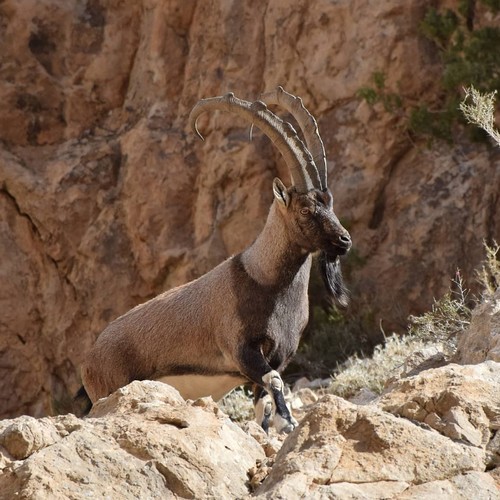
Wild Goat
Capra aegagrus
With their magnificent scimitar horns and gravity-defying climbing skills, Wild Goats are the legendary sentinels of Asia's most rugged mountain ranges. As the primary ancestor of the modern domestic goat, these resilient survivors offer a fascinating glimpse into the wild roots of our most familiar farm animals.
Quick Identification
Size
120-160 cm (47-63 in) in length; 25-95 kg (55-210 lbs)
Colors
Silver-grey to yellowish-brown coat; males have a black beard, chest markings, and a dark dorsal stripe.
Key Features
- Massive scimitar-shaped horns up to 140 cm in males
- Distinctive black facial markings and chin beard
- Dark stripe running down the length of the spine
- Muscular build with sturdy hooves for rock climbing
When You’ll See Them
Geographic range
Where Does the Wild Goat Live?
The Wild Goat is native to the rugged highlands of Western and Central Asia. Its core range spans from the Taurus Mountains in Turkey and the Caucasus region through the rocky landscapes of Iran and Turkmenistan, extending eastward into the craggy peaks of Afghanistan and Pakistan. While they are mountain specialists, some isolated and introduced populations exist on Mediterranean islands and in specialized game preserves in the United States, though these are often descended from ancient domestic or hybrid stock.
Basemap © OpenStreetMap contributors
Behavior
Wild Goats are highly social and agile mammals, best known for their incredible ability to navigate nearly vertical cliffs and rocky terrain. They typically live in herds, which can vary in size from small family units to larger groups of over 30 individuals. Their social structure is largely segregated by sex; females and their offspring form stable nurseries, while adult males remain solitary or join small bachelor groups for most of the year. During the autumn rut, males engage in dramatic displays of dominance, clashing their massive horns to win breeding rights.
These goats are primarily crepuscular, meaning they are most active during the cooler hours of dawn and dusk. They spend the middle of the day resting in the shade of cliffs or thickets to avoid the midday heat. While they are naturally wary and shy around humans, they are remarkably bold when it comes to climbing, often scaling steep rock faces that would be inaccessible to most other large mammals to escape predators like leopards or wolves.
EverydayEarth exclusive
Camera Tips
To capture high-quality footage of Wild Goats, placement is the most critical factor. Because these animals are adapted for steep environments, look for 'game trails' that skirt along the edges of cliffs or traverse rocky ridges. Set your camera at a height of approximately 3 feet (1 meter), but be mindful of the slope; if you are pointing the camera uphill or downhill, adjust the angle so the sensor triggers on the animal's core rather than just its legs. Using a wide-angle lens is often beneficial in their open, rocky habitats to capture the scale of their environment.
Water is a powerful magnet for Wild Goats, particularly in the arid parts of their range in Iran and Pakistan. Placing a camera near a secluded spring, mountain seep, or cattle trough during the dry season will yield consistent results. If you are in a region where it is permitted, a mineral or salt block can serve as an excellent long-term lure, as these goats crave salts to balance their diet. They are curious animals, so ensure your camera is housed in a rugged, weather-proof casing and securely fastened to a rock or sturdy tree, as they have been known to nudge or rub against equipment.
Lighting in mountain environments can be tricky. Try to position your camera facing North or South to avoid the direct 'sun flare' during the dawn and dusk periods when the goats are most active. Because Wild Goats are social, setting your camera to 'Burst Mode' or 'Video' is highly recommended. A 20-second video clip is far more valuable than a single still image, as it allows you to observe their social hierarchy, climbing techniques, and the impressive horn-clashing behavior that occurs during the rutting season in late autumn.
Similar Species
Species that look similar or are commonly confused with Wild Goat.
Alpine Ibex
Ibex have much thicker, knobbier horns and lack the dark shoulder and chest markings often seen in male Wild Goats.
Markhor
The Markhor is easily distinguished by its spectacular corkscrew-shaped horns and a much longer, shaggier coat on the neck and chest.
Domestic Goat
Domestic goats come in a vast array of colors and ear shapes; they generally lack the consistent 'wild' markings and the uniform scimitar horn shape of the Wild Goat.
Frequently Asked Questions
Record Wild Goat at your habitat
Connect a camera to start building your own species record — AI identifies every visitor automatically.