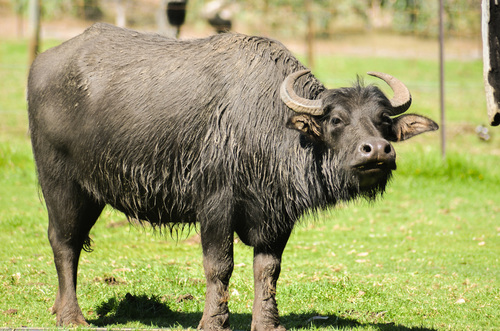
Domestic Water Buffalo
Bubalus bubalis
The Domestic Water Buffalo is a gentle, semi-aquatic giant that thrives where land meets water. Known as the 'Living Tractor' of the East, these intelligent bovines are famous for their massive horns and love for deep mud wallows.
Quick Identification
Size
Standing 1.2 to 1.6 meters (4 to 5.2 feet) at the shoulder; weighing between 300 and 1,100 kg (660 to 2,425 lbs)
Colors
Typically slate grey to black skin; some individuals feature white 'stockings' on the legs or a white chevron on the neck
Key Features
- Massive backward-curving or crescent-shaped horns
- Sparsely haired, thick dark skin
- Wide, splayed hooves for walking in mud
- Broad, flat forehead with low-slung head carriage
When You’ll See Them
Geographic range
Where Does the Domestic Water Buffalo Live?
Originally native to the tropical and subtropical regions of the Indian subcontinent and Southeast Asia, the Domestic Water Buffalo has been introduced to nearly every continent. They are a defining feature of the landscape in countries like India, Vietnam, and China, but they also thrive in the marshlands of Italy, parts of South America, and the Northern Territory of Australia. Because they require constant access to water, their range is closely tied to river basins and humid coastal plains rather than arid highlands.
Basemap © OpenStreetMap contributors
Behavior
In a social context, they form strong bonds within their herds, which are typically led by a dominant matriarch. They are remarkably docile and cooperative with humans, a trait that has made them invaluable for agriculture for millennia. However, they remain highly protective of their calves and can show surprising agility and strength if they perceive a threat from predators.
EverydayEarth exclusive
Camera Tips
Placement is critical; avoid pointing the camera directly at the water’s surface to prevent sun glint from triggering the sensor or washing out the image. Instead, aim the lens at the muddy banks or the 'staging area' where they gather before entering the water. If your camera allows for adjustable trigger sensitivity, set it to medium; their large size makes them easy to detect, but you want to avoid capturing every ripple in the water or movement of tall reeds.
Nighttime captures require specific attention to infrared (IR) settings. Water Buffalo skin absorbs a lot of light, so set your IR flash to the 'Long Range' or 'High' setting to ensure they don't appear as a giant black blob in the frame. Video mode is highly recommended over still photos, as it better captures their social vocalizations and the fascinating way they use their horns to shovel mud onto their backs.
Finally, protect your equipment. Water Buffalo are notoriously curious and extremely strong. They may use a camera mounting post as a convenient scratching post, which can easily snap a standard wooden stake or knock a camera out of alignment. Use a heavy-duty steel security box and secure the camera to a large, established tree or a deeply anchored metal post to ensure your gear survives an encounter with a 2,000-pound animal.
Similar Species
Species that look similar or are commonly confused with Domestic Water Buffalo.
Wild Water Buffalo
Much larger and more aggressive with massive, wider-reaching horns; strictly found in protected wild areas of Asia.
African Buffalo
Found only in Africa; features a distinctive bone 'boss' shield across the forehead where the horns meet.
Domestic Cattle
Typically lack the semi-aquatic behavior and wide, splayed hooves; skin is usually fully furred rather than mostly bare.
Frequently Asked Questions
Record Domestic Water Buffalo at your habitat
Connect a camera to start building your own species record — AI identifies every visitor automatically.