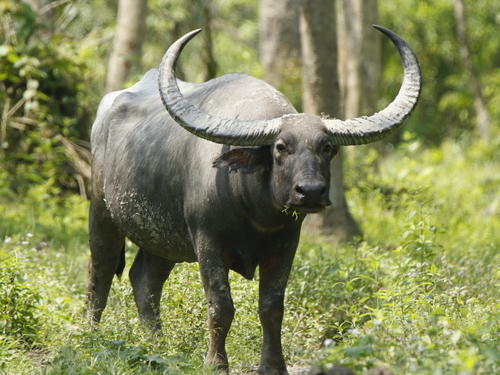
Wild Water Buffalo
Bubalus arnee
Witness the raw power of the Indian subcontinent's largest bovine. With horns that can span over six feet, the Wild Water Buffalo is the undisputed king of the wetlands.
Quick Identification
Size
Length of 240-300 cm (94-118 in), shoulder height of 150-190 cm (59-75 in), and weight between 600-1200 kg (1320-2645 lbs).
Colors
Dull ash-gray to black skin; sparse hair; lower legs often have lighter, off-white markings or 'stockings' reaching the hooves.
Key Features
- Massive outward-curving crescent horns spanning up to 2 meters
- Broad, heavy-set body with a prominent dorsal ridge
- Large, splayed hooves for stability in mud
- Sparse, dark coat with a tufted tail
When You’ll See Them
Behavior
Wild Water Buffalo are highly social and water-dependent bovines. They typically congregate in maternal herds led by an old matriarch, consisting of females and their young. Adult males are generally more solitary, though they may form small bachelor groups or join the female herds during the mating season. Their daily rhythm is dictated by the sun; they spend the hottest parts of the day submerged in water or mud wallows to cool down and protect their skin from biting insects.
Unlike their more docile domesticated counterparts, the true wild species is known for its fierce and unpredictable temperament. They are incredibly powerful and have been known to stand their ground against predators like tigers. They are remarkably agile in wetlands, using their splayed hooves to navigate deep mud that would trap other large mammals. While they are wary of humans, they can become very protective of their calves, making them one of the more dangerous large mammals to encounter in the wild.
EverydayEarth exclusive
Camera Tips
To successfully capture the Wild Water Buffalo on camera, you must focus on their essential need for thermoregulation. Locate active wallows—shallow, muddy depressions filled with water—and place your camera on the approach path or overlooking the mud. These wallows are social hubs where the buffalo spend hours. Because these animals are massive, mount your camera higher than usual, roughly 4 to 5 feet (1.2 to 1.5 meters) off the ground, and angle it slightly downward. This prevents the animal's large body from filling the entire frame and ensures you capture those impressive horns.
Wide-angle lenses are a huge advantage when dealing with megafauna. If your camera allows, use a wider field of view to capture the entire herd rather than just a single flank. Position the camera at least 15-20 feet away from the trail or wallow center. During the dry season, water is the ultimate draw; focusing your setup on the few remaining permanent water holes in their territory will almost guarantee sightings. Use a high-quality SD card with fast write speeds, as a herd of buffalo can trigger dozens of photos in a single visit.
Durability is a major concern with this species. Wild Water Buffalo are curious and incredibly strong; they may rub against your camera or investigate it with their horns. Always use a heavy-duty steel security box (bear box) and secure it to a thick, sturdy tree using a python cable or lag bolts. Avoid using scented lures, as this may encourage the animals to lick or damage the equipment. Setting your camera to 'Hybrid Mode' (capturing both a photo and a short video) is recommended to capture the fascinating social dynamics and the characteristic 'mud-shaking' behavior after a wallow.
Similar Species
Species that look similar or are commonly confused with Wild Water Buffalo.
Frequently Asked Questions
Record Wild Water Buffalo at your habitat
Connect a camera to start building your own species record — AI identifies every visitor automatically.