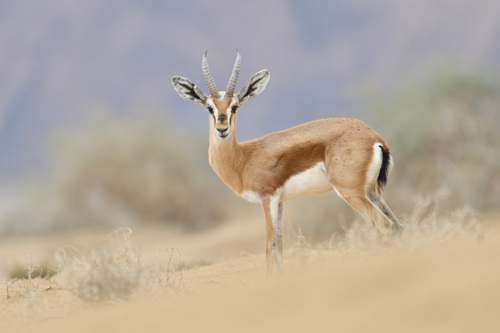
Dorcas Gazelle
Gazella dorcas
A slender ghost of the dunes, the Dorcas Gazelle is the ultimate desert survivor. With its lyre-shaped horns and incredible speed, this resilient antelope thrives where few other mammals can.
Quick Identification
Size
Shoulder height: 55–65 cm (21–26 in); Length: 90–110 cm (35–43 in); Weight: 15–20 kg (33–44 lb)
Colors
Sandy-beige or reddish-brown coat with a white underbelly; a dark brown stripe separates the flank from the belly; white facial stripes and a dark tail.
Key Features
- Elegant lyre-shaped horns with 15-25 prominent rings
- Thin dark stripe along the flank
- Distinctive white facial stripes running from eye to muzzle
When You’ll See Them
Geographic range
Where Does the Dorcas Gazelle Live?
Native to the vast desert belts of Northern Africa and the Middle East, the Dorcas Gazelle occupies a sprawling range that stretches from the Atlantic coast of Morocco and Mauritania across the Sahara to Egypt and the Horn of Africa. Its territory extends across the Red Sea into the Arabian Peninsula, with core populations found in Israel, Jordan, and Saudi Arabia. While they are resilient survivors, their range has become increasingly fragmented in the Levant and parts of the Sahel due to habitat encroachment.
Basemap © OpenStreetMap contributors
Behavior
The Dorcas Gazelle is a marvel of desert adaptation, capable of surviving its entire life without ever drinking liquid water. They derive all necessary moisture from the succulent plants, bulbs, and Acacia leaves they consume. To conserve energy in the scorching heat, their social structure and activity levels are highly flexible; they may live in pairs or small family groups, but can congregate in herds of up to 40 individuals when food is seasonally abundant.
These gazelles are famous for 'stotting'—a high-leaping behavior used to signal to predators that they have been spotted and are too fit to be caught. While they are naturally diurnal in cooler weather, they shift to a crepuscular or even fully nocturnal lifestyle during the height of summer to avoid heat stress. Their incredible speed, reaching up to 80 km/h (50 mph), makes them one of the fastest land mammals in their range.
EverydayEarth exclusive
Camera Tips
To successfully capture a Dorcas Gazelle on camera, you must focus on 'hotspots' in an otherwise sparse landscape. In arid environments, dry riverbeds or 'wadis' serve as natural highways for wildlife; placing your camera along these corridors, especially where they intersect with Acacia groves, is your best bet. These gazelles are highly attracted to the shade and fallen seed pods of Acacia trees, making the base of these trees an ideal focal point for your lens.
Because Dorcas Gazelles are relatively small, mount your camera lower than you would for a deer—approximately 50 centimeters (20 inches) off the ground is perfect for eye-level shots. They are exceptionally skittish, so using a 'No-Glow' or Black IR flash is mandatory; a standard red-glow flash will likely startle them and prevent them from returning to the site. Ensure your camera has a very fast trigger speed, as they often move with a quick, nervous energy even when feeding.
Environmental factors are key to camera maintenance in their habitat. Use high-quality lithium batteries to withstand extreme desert temperature fluctuations and ensure your camera housing is well-sealed against fine sand and dust. If you are in a region where it is legal and ethical, a salt lick or a small, concealed water source can be an irresistible draw, but the most natural results come from placing cameras near their favorite browse plants during the early morning hours when the desert light is soft.
Similar Species
Species that look similar or are commonly confused with Dorcas Gazelle.
Frequently Asked Questions
Record Dorcas Gazelle at your habitat
Connect a camera to start building your own species record — AI identifies every visitor automatically.