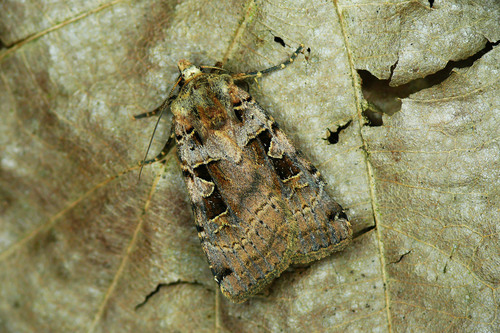
Double Square-spot
Xestia triangulum
With its distinctive twin dark marks and warm, earthy tones, the Double Square-spot is a hallmark of the mid-summer night. A frequent visitor to backyard light traps, this moth offers a fascinating glimpse into the nocturnal biodiversity of temperate gardens.
Quick Identification
Size
Wingspan of 36–46 mm (1.4–1.8 inches)
Colors
Forewings are typically pale ochreous to reddish-brown with two distinct, dark blackish-brown square or triangular spots.
Key Features
- Two prominent dark, square-shaped spots on the forewings
- Pale, ochre-brown to reddish-brown base color
- Smooth, slightly satiny wing texture
- Large, pale-ringed kidney-shaped mark (reniform stigma) next to the squares
- Faintly marked pale hindwings with a slight greyish tint
When You’ll See Them
Geographic range
Where Does the Double Square-spot Live?
Native to the Palearctic region, the Double Square-spot is found across nearly all of Europe, stretching from the British Isles to the vast forests of Siberia. While it avoids the far northern reaches of Fennoscandia and most Mediterranean islands, it is well-established in temperate countries like France, Germany, and the UK. In the southeastern part of its range, the population extends toward the Black Sea and into Northern Iran.
Basemap © OpenStreetMap contributors
Behavior
The Double Square-spot is a quintessential nocturnal moth, common throughout temperate gardens and woodlands during the height of summer. By day, it is a master of camouflage, resting low in dense vegetation or among fallen leaves where its earthy tones make it nearly invisible to predators. It emerges at twilight to begin its search for food and mates, often becoming most active during the darkest hours of the night.
Unlike some more specialized moths, the Double Square-spot is a generalist when it comes to movement, frequently visiting various nectar sources. It is famously attracted to artificial light sources, making it a regular guest at porch lights and backyard moth traps. While solitary by nature, it isn't uncommon to find several individuals congregating in areas with abundant flowering plants or near fermented sugar baits.
EverydayEarth exclusive
Camera Tips
To capture the Double Square-spot on an AI-powered camera, the most effective setup is a light-attraction station. Mount your camera approximately 3 to 5 feet off the ground, facing a vertical white sheet illuminated by a UV or mercury vapor lamp. This 'moth wall' allows the camera to focus on a flat plane, ensuring the moth's intricate wing patterns and square markings are sharp and clear.
If you prefer a baiting method, 'wine-ropes' or 'sugar-paints' are excellent lures. Mix brown sugar, black treacle, and a bit of stale beer, then paint this mixture onto tree trunks or soak thick ropes in it and hang them at eye level. Position your camera on a tripod roughly 18-24 inches from the bait. Because moths are small and their movement can be erratic, use a high-sensitivity motion trigger setting or time-lapse mode to ensure you don't miss their arrival.
Optimal timing is crucial for this species; plan your camera sessions for warm, humid, and overcast nights in July or August, as these are the peak conditions for activity. Avoid nights with a bright full moon or high winds, which tend to discourage moths from flying. If your camera has a macro setting or a close-focus lens, use it to capture the fine details of the 'squares' that give this species its name.
Similar Species
Species that look similar or are commonly confused with Double Square-spot.
Frequently Asked Questions
Record Double Square-spot at your habitat
Connect a camera to start building your own species record — AI identifies every visitor automatically.