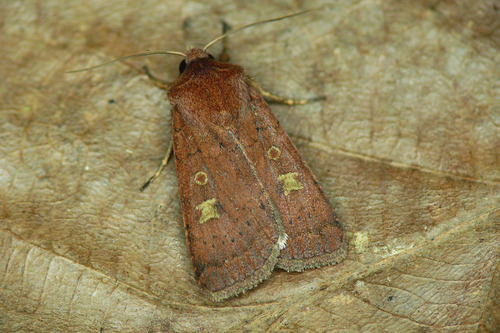
Square-spot Rustic
Xestia xanthographa
A classic late-summer visitor, the Square-spot Rustic is easily identified by the neat, pale 'windows' on its wings. This resilient moth is a common and welcome sight for backyard nature observers across the Northern Hemisphere.
Quick Identification
Size
Wingspan of 30–40 mm (1.2–1.6 inches); body length approximately 15–20 mm (0.6–0.8 inches)
Colors
Variable forewings ranging from clay-yellow and sandy-brown to deep reddish-brown or greyish; features two distinct pale cream or yellowish spots
Key Features
- Distinctive pale, square-shaped kidney mark (reniform stigma)
- Two pale, prominent spots on each forewing
- Variable ground color from light tan to dark brown
- Pale silky-grey hindwings with darker veining
When You’ll See Them
Geographic range
Where Does the Square-spot Rustic Live?
The Square-spot Rustic is a widespread inhabitant of the Palearctic region, naturally occurring from the United Kingdom across Europe into North Africa and through Northern Asia. It has also successfully established itself as an introduced species in North America, where it is now commonly found throughout the Pacific Northwest and parts of the Northeast. This adaptable moth thrives in a wide range of climates, making it a familiar sight in both rural landscapes and urban backyards.
Basemap © OpenStreetMap contributors
Behavior
The Square-spot Rustic is a hardy and adaptable nocturnal visitor, frequently seen during the late summer months. It is one of the most common members of the 'Noctuid' family, often appearing in large numbers in suburban gardens. Unlike some specialists, this moth is a generalist; it is an active flier that readily visits late-season flowers for nectar and is a frequent guest at backyard light traps and sugar lures.
During the daylight hours, these moths remain well-camouflaged against tree bark or within dry leaf litter. Their larvae are equally resilient, remaining active throughout the winter during mild spells to feed on various grasses. Because of their sheer abundance, Square-spot Rustics serve as a vital food source for bats and nocturnal birds, making them an essential pillar of the backyard food web.
EverydayEarth exclusive
Camera Tips
Capturing the Square-spot Rustic on an AI-powered camera requires a bit of 'moth-erly' ingenuity. Since these insects are strictly nocturnal, standard trail cameras need to be positioned near a lure to guarantee a sighting. Setting up a 'sugar patch'—a thick mixture of dark sugar, molasses, and fermented beer painted onto a tree trunk at chest height—is a highly effective way to draw them in. Aim your camera at the patch from about 2 to 3 feet away to ensure the macro-focus can pick up the distinct square markings.
Using a camera with a high-speed trigger is essential, as moths can be flighty and sensitive to movement. If your device has a 'Macro' or 'Close-up' mode, enable it to capture the subtle textures of the wings. To get the best color representation, use a camera with a white-light flash if possible; while infrared works, the white light helps distinguish the species' characteristic reddish-brown hues from its grey variants.
Timing is everything with this species. In most temperate regions, you will see the highest activity during humid, overcast nights in late August. Avoid setting your gear on very windy nights, as the Square-spot Rustic prefers to stay hunkered down in the grass when conditions are blustery. For a more natural look, place your camera near late-blooming nectar sources like Ivy or Michaelmas daisies.
Similar Species
Species that look similar or are commonly confused with Square-spot Rustic.
Frequently Asked Questions
Record Square-spot Rustic at your habitat
Connect a camera to start building your own species record — AI identifies every visitor automatically.