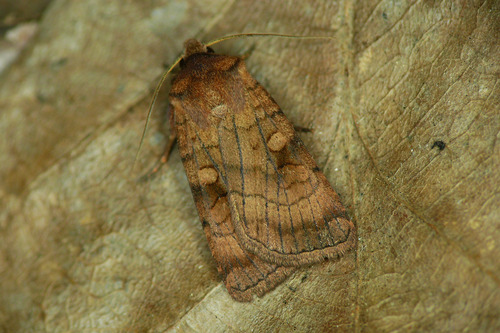
Six-striped Rustic
Xestia sexstrigata
With its warm cinnamon tones and elegant geometric markings, the Six-striped Rustic is a classic visitor of the European summer night. This moisture-loving moth turns damp garden corners into a showcase of subtle natural beauty.
Quick Identification
Size
Wingspan of 34–38 mm (1.3–1.5 inches)
Colors
Warm reddish-brown or ochreous-brown forewings with dark transverse lines; pale grey or brownish-grey hindwings
Key Features
- Six distinct dark transverse lines across the forewing
- Warm reddish-brown to cinnamon base color
- Clearly defined kidney and ring marks (stigmata)
- Rounded wing shape typical of the Noctuidae family
When You’ll See Them
Geographic range
Where Does the Six-striped Rustic Live?
The Six-striped Rustic is a native resident of Europe, found across the majority of the continent except for the most southern Mediterranean reaches. It is particularly common throughout the British Isles, France, the Benelux countries, and central Europe, extending northwards into southern Scandinavia. Because it thrives in temperate, moist climates, it is a frequent sight in the lush landscapes of Northern and Western Europe.
Basemap © OpenStreetMap contributors
Behavior
The Six-striped Rustic is a dedicated nocturnal traveler, most active during the warmest weeks of mid-to-late summer. Unlike some moths that fly sporadically throughout the year, this species has a very focused flight window, during which it can be found hovering around nectar-rich flowers or darting toward artificial light sources. During the day, it utilizes its earthy coloration to remain hidden, tucking itself deep into damp vegetation or resting against the bark of trees where its stripes mimic the natural shadows of the forest floor.
While it is a solitary flyer, it is not uncommon to see several individuals congregating in areas with high moisture content, such as marshes or well-watered gardens. They are relatively docile when feeding, allowing for close observation if approached quietly with a red-filtered light. They serve a vital role in the ecosystem as a food source for bats and as secondary pollinators for evening-blooming plants.
EverydayEarth exclusive
Camera Tips
To successfully capture the Six-striped Rustic on your backyard AI camera, timing is everything. This moth is strictly seasonal, so focus your efforts during its peak flight period from mid-July to late August. Because these moths are relatively small, you should position your camera as close as possible to the target area—ideally between 12 and 24 inches. If your camera has a macro lens or a focal adjustment for close-up wildlife, this is the time to use it.
The most effective 'lure' for this species is a practice called 'sugaring.' Create a thick, fermented mixture of dark brown sugar, treacle, and a splash of ale or overripe mashed bananas. Paint this onto a fence post or a tree trunk within your camera's field of view. The Six-striped Rustic is highly attracted to these sweet, fermenting scents and will often spend several minutes stationary while feeding, providing the perfect opportunity for a clear, high-resolution image.
Lighting is a challenge for night-time moth photography. Standard infrared (IR) flashes can sometimes 'blow out' the delicate markings on the wings, making the six stripes hard to see. For the best results, use a camera with a 'starlight' sensor or low-intensity white light LEDs. If your camera only uses IR, try placing a piece of semi-transparent tape over the flash to diffuse the light, or set the camera to a slightly lower exposure setting to preserve the detail in the moth's wing patterns.
Similar Species
Species that look similar or are commonly confused with Six-striped Rustic.
Square-spotted Clay
The Square-spotted Clay usually has a darker, more rectangular mark between the wing spots and lacks the six clear, straight transverse lines.
Triple-spotted Clay
This species has more distinct spots and a generally smoother wing texture without the heavy 'six-striped' appearance.
Frequently Asked Questions
Record Six-striped Rustic at your habitat
Connect a camera to start building your own species record — AI identifies every visitor automatically.