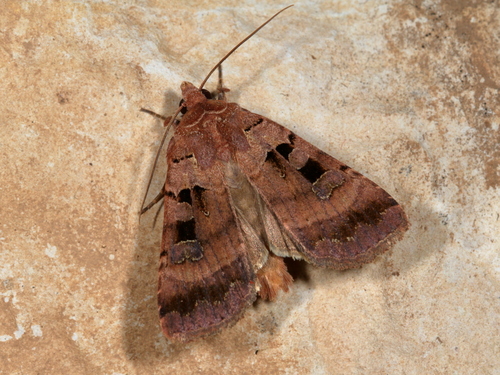
Square-spotted Clay
Xestia stigmatica
A gem of the late-summer garden, the Square-spotted Clay is easily recognized by the bold geometric markings on its velvety brown wings. This hardy nocturnal moth is a favorite for backyard observers across Europe and Western Asia.
Quick Identification
Size
Wingspan of 37–44 mm (1.4–1.7 inches)
Colors
Rich reddish-brown or purplish-brown forewings with a prominent dark square spot; hindwings are a smoky brownish-grey.
Key Features
- Distinctive dark square spot (stigma) located between the orbicular and reniform markings
- Rich chocolate or purplish-brown ground color
- Pale subterminal line near the wing edge
- Wings held flat over the body in a triangular shape when at rest
When You’ll See Them
Geographic range
Where Does the Square-spotted Clay Live?
The Square-spotted Clay is native to the Palearctic realm, with a distribution that spans across most of temperate Europe. Its range extends eastward through the Caucasus and Transcaucasia into Kazakhstan, reaching as far as northern Turkey and northern Iran. While common in its preferred habitats, it is most frequently recorded in the United Kingdom, France, and Germany where deciduous woodland and established garden suburbs provide ideal conditions.
Basemap © OpenStreetMap contributors
Behavior
The Square-spotted Clay is a nocturnal moth that emerges during the height of summer. During the day, it is a master of concealment, resting motionless among leaf litter or against the dark bark of trees where its earthy tones provide near-perfect camouflage. It is generally a solitary flyer, though it can be found in higher concentrations in areas with abundant nectar sources or larval food plants.
Unlike some moths that are purely attracted to light, the Square-spotted Clay is also a frequent visitor to 'sugar'—a mixture of fermented sweets and alcohol used by enthusiasts to attract nocturnal insects. It has a relatively steady, low flight pattern and is often observed crawling over flowers rather than hovering. It plays a minor but helpful role in the pollination of late-summer wildflowers and garden shrubs.
EverydayEarth exclusive
Camera Tips
To capture high-quality images of the Square-spotted Clay, you should utilize a 'light-trap' setup in front of your camera. Hang a white cotton sheet vertically and position a UV or actinic light source to shine upon it. Place your camera on a tripod approximately 1-2 feet away from the sheet. When the moth lands on the white fabric to investigate the light, the contrast will allow your camera's AI to easily detect and focus on the intricate wing patterns.
Sugar baiting is another exceptional method for this specific species. Mix overripe bananas, brown sugar, and a splash of dark ale into a thick slurry and paint it onto a fence post or tree trunk at eye level. Mount your camera 3 feet away, facing the bait. The Square-spotted Clay is highly attracted to these fermenting scents and will often stay stationary for long periods while feeding, allowing for crisp, clear photos that aren't possible during flight.
Because these moths are most active on warm, still, and humid nights, monitor the weather forecast and set your equipment out when the overnight temperature is expected to stay above 10°C (50°F). Use the macro setting on your camera if available, and rely on infrared (IR) night vision to avoid startling the moth with a harsh white flash. If you are using a motion-triggered camera, ensure the sensitivity is set to high, as the gentle fluttering of a moth may not trigger lower settings.
Similar Species
Species that look similar or are commonly confused with Square-spotted Clay.
Frequently Asked Questions
Record Square-spotted Clay at your habitat
Connect a camera to start building your own species record — AI identifies every visitor automatically.