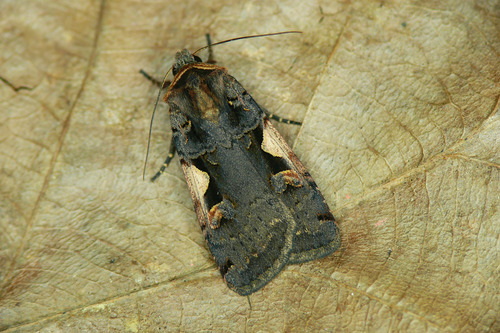
Setaceous Hebrew Character
Xestia c-nigrum
Named for the cryptic, ancient-looking symbol on its wings, the Setaceous Hebrew Character is a master of the night. This resilient moth is a frequent visitor to backyard gardens across the Northern Hemisphere.
Quick Identification
Size
Wingspan of 35–45 mm (1.4–1.8 inches); Body length approx 18–22 mm (0.7–0.9 inches)
Colors
Forewings are typically a rich reddish-brown or purplish-brown, featuring a prominent black mark next to a cream-colored triangular patch. Hindwings are a translucent smoky-white with darker veins.
Key Features
- Distinct black 'C-shaped' or 'nun' mark on the forewing
- Creamy-white triangular patch bordering the black mark
- Rich reddish-brown ground color with a velvety texture
- Two-toned wings with lighter, grayish-white hindwings
- Typical 'Noctuid' resting position with wings folded flat over the back
When You’ll See Them
Geographic range
Where Does the Setaceous Hebrew Character Live?
Native across a massive expanse of the Northern Hemisphere, this moth is found throughout the Palearctic realm from the British Isles across Europe to Japan and Korea. In North America, it thrives from coast to coast across Canada and the northern United States, extending southward through the Rocky Mountains into Arizona and New Mexico. It is an incredibly hardy species that has successfully colonized almost every temperate environment in the Holarctic region.
Basemap © OpenStreetMap contributors
Behavior
The Setaceous Hebrew Character is a highly successful nocturnal moth known for its strong flight and adaptable nature. During the day, it remains perfectly still, resting on tree trunks, fences, or hidden within low-lying foliage. Its mottled brown coloration provides excellent camouflage against bark, protecting it from avian predators. Once dusk falls, it becomes highly active, seeking out nectar sources or mates.
This species is particularly well-known for its attraction to artificial light sources, making it a frequent visitor to porch lights and lighted windows. Unlike some moth species that have a very short flight window, the Setaceous Hebrew Character typically produces two generations per year (and sometimes a third in warmer climates), meaning it can be spotted from late spring all the way through the first frosts of autumn. It is a solitary creature, though many individuals may congregate around a single high-quality food source or light trap.
EverydayEarth exclusive
Camera Tips
To capture high-quality images of the Setaceous Hebrew Character, an AI-powered camera should be positioned near a light source or a bait station. These moths are strongly phototactic, so placing a camera near a UV lamp or a white sheet illuminated by a porch light is the most effective way to guarantee a 'visit.' Set your camera's focus distance to a fixed point on the landing surface—usually about 12 to 18 inches away—to ensure the intricate wing patterns are sharp.
For those who prefer a more natural setup, 'sugaring' is a classic and highly effective technique. Mix overripe bananas, dark brown sugar, and a bit of stout or beer into a thick paste and let it ferment for a day. Paint this mixture onto a tree trunk at eye level and mount your camera nearby. The Setaceous Hebrew Character is a frequent visitor to these sweet, fermented stations, and they often stay still for long periods while feeding, allowing for excellent macro shots that reveal the distinctive 'C' mark on their wings.
Since these moths are most active on warm, humid, and overcast nights, check your local weather forecast for nights when the temperature stays above 10°C (50°F). In your camera settings, utilize a fast trigger speed or a burst mode. If your equipment supports infrared (IR) night vision, ensure the IR intensity is balanced; the reflective scales on moth wings can sometimes 'blow out' or overexpose the image if the flash is too close. A slight angle to the side rather than a direct frontal flash often yields better detail.
Similar Species
Species that look similar or are commonly confused with Setaceous Hebrew Character.
Frequently Asked Questions
Record Setaceous Hebrew Character at your habitat
Connect a camera to start building your own species record — AI identifies every visitor automatically.