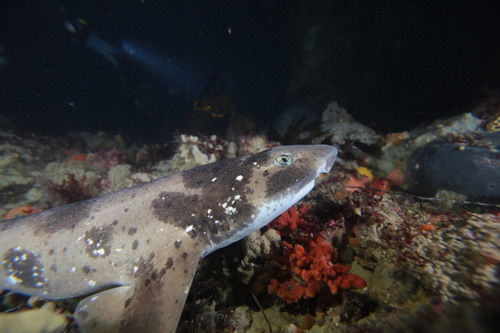
Draughtboard Shark
Cephaloscyllium laticeps
The Draughtboard Shark is southern Australia's master of underwater camouflage. Known for its ability to puff up like a balloon to deter predators, this 'swellshark' is a fascinating nocturnal resident of our rocky reefs.
Quick Identification
Size
Typically reaches 1 metre (3.3 feet) in length, with a maximum recorded size of 1.5 metres (4.9 feet).
Colors
Complex pattern of large, dark brown or greyish-black patches on a lighter yellowish-brown or grey background, resembling a draughtboard (checkerboard). The underside is usually pale with sparse spotting.
Key Features
- Broad, flattened head with a short, rounded snout
- First dorsal fin is significantly larger than the second
- Lacks the tail fin notch found in many other sharks
- Can double its size by inflating its stomach with water or air
When You’ll See Them
Geographic range
Where Does the Draughtboard Shark Live?
The Draughtboard Shark is a proud resident of the cool, temperate waters surrounding the southern half of the Australian continent. It is found from the central coast of New South Wales, wrapping south around the entire coast of Tasmania, and extending westward through the Great Australian Bight to central Western Australia. This species is endemic to Australia, meaning it is found nowhere else on Earth, thriving in the nutrient-rich currents of the southern shelf.
Basemap © OpenStreetMap contributors
Behavior
The Draughtboard Shark is a sluggish, bottom-dwelling predator that spends most of its daylight hours resting. It is a social species, often found huddling in groups within rocky crevices, under ledges, or tucked away in dense kelp forests. Despite their somewhat intimidating appearance, they are non-aggressive toward humans, though they are known to be quite curious about divers and underwater equipment.
Its most famous trait is its ability to 'swell.' When threatened by a predator, the shark gulps in a large amount of water or air, expanding its body girth significantly. This makes it much harder for a predator to pull the shark out of a rocky crevice or to swallow it. At night, the shark becomes a methodical hunter, prowling the reef floor using its keen sense of smell and electroreception to find hidden prey.
EverydayEarth exclusive
Camera Tips
To capture the Draughtboard Shark on film, you will need a specialized underwater 'trail cam' or a baited remote underwater video (BRUV) setup. Position your camera on the seafloor at the edge of a rocky reef or near the base of a kelp forest. These sharks are benthic, so the camera should be mounted no more than 30-50 centimeters (12-20 inches) above the substrate, angled slightly downward to capture the shark as it 'walks' or swims along the bottom.
Bait is the secret to a successful 'backyard' marine observation. Use a secure, perforated bait container filled with oily fish like pilchards, sardines, or mackerel. Anchor the bait about 1.5 meters (5 feet) in front of the lens. The scent will travel with the current, acting as a dinner bell for any Draughtboard Sharks in the area. Since they are most active at night, ensure your camera has high-quality infrared LEDs or a motion-activated white light that won't startle the wildlife.
During the day, you can occasionally find them resting in the same spots. If you know of a rocky ledge or cave in shallow water, you can mount a stationary camera nearby to catch them emerging at dusk. Because marine environments are harsh, always double-check your seals and rinse your camera housing with fresh water after every deployment to prevent salt buildup and corrosion. Set your camera to record 30-second clips, as these sharks often linger around the bait, providing excellent opportunities for behavioral study.
Similar Species
Species that look similar or are commonly confused with Draughtboard Shark.
Frequently Asked Questions
Record Draughtboard Shark at your habitat
Connect a camera to start building your own species record — AI identifies every visitor automatically.