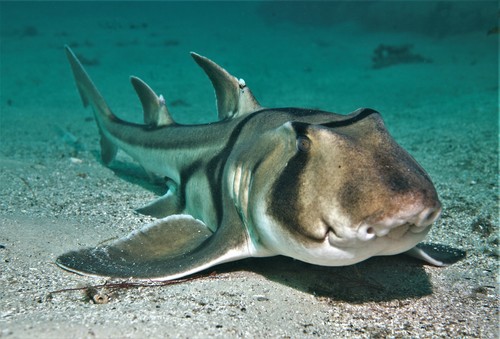
Port Jackson Shark
Heterodontus portusjacksoni
With its quirky 'pig-like' face and striking harness-shaped markings, the Port Jackson Shark is the gentle, rock-dwelling resident of Australia's southern reefs. Famous for its spiral egg cases and docile nature, this nocturnal cruiser is a favorite for backyard coastal explorers.
Quick Identification
Size
Typically 75–120 cm (2.5–4 ft), reaching a maximum of 165 cm (5.5 ft); weights up to 20 kg (44 lbs).
Colors
Light grey-brown base color with distinct dark brown 'harness' markings across the eyes, back, and sides. Underside is pale creamy white.
Key Features
- Large blunt head with prominent ridges over the eyes
- Dark harness-like markings forming a 'Y' or 'V' shape on the sides
- Small venomous spine on the leading edge of both dorsal fins
- Small mouth with 'pig-like' nostrils at the front of the head
When You’ll See Them
Geographic range
Where Does the Port Jackson Shark Live?
The Port Jackson Shark is a quintessential Australian native, found primarily in the temperate waters surrounding the southern half of the continent. Its core range extends from the southern coast of Queensland near Brisbane, winding all the way along the New South Wales and Victorian coastlines, through the Great Australian Bight, and reaching up to the central coast of Western Australia. While they are most abundant in the shallow coastal shelf waters of the South Pacific and Indian Oceans, they are a frequent sight for seaside residents in major hubs like Sydney, Melbourne, and Adelaide.
Basemap © OpenStreetMap contributors
Behavior
The Port Jackson Shark is a docile, nocturnal species that spends the daylight hours resting in quiet rocky crevices, caves, or on sandy seafloors. They are highly social within their preferred resting spots, often found huddled together in large groups. Despite their somewhat intimidating shark lineage, they are non-aggressive towards humans and are often observed by divers as 'sleeping' on the bottom during the day.
As night falls, these sharks become active hunters, using their highly developed senses to locate prey along the seabed. They exhibit a fascinating annual migration, traveling hundreds of kilometers to return to the same breeding grounds each winter. During the breeding season, females lay unique, corkscrew-shaped egg cases which they wedge into rock crevices using their mouths to protect the developing pups from predators.
EverydayEarth exclusive
Camera Tips
Capturing the Port Jackson Shark requires a specialized approach, as they are strictly aquatic. For coastal backyard enthusiasts or pier-dwellers, an underwater trail camera or a stationary GoPro setup is essential. During the winter breeding season (June to October), these sharks move into very shallow waters, sometimes as shallow as two meters, making them accessible to cameras mounted on private jetties or weighted on the edge of rocky reefs. Look for 'gutters' or sandy patches adjacent to reef edges, as these are their primary travel corridors.
Since they are nocturnal, your camera must have strong infrared (IR) capabilities or be paired with a low-intensity underwater light. However, be cautious with bright white lights, as they can startle the sharks. Placement is best at a low angle, roughly 30cm off the seabed, facing a clear sandy area where their dark harness markings will contrast sharply against the lighter substrate. If you are using a camera with a motion sensor, ensure it is calibrated for underwater use, as moving kelp can trigger false positives.
To attract them to your lens, a scent-based lure is more effective than visual bait. Use a perforated PVC tube filled with oily fish like sardines or mackerel (locally known as a 'burley cage'). Secure the lure approximately one meter in front of the camera. The sharks' keen electroreceptors and sense of smell will lead them directly to the source. Be sure to use a heavy weight or a sand anchor for your camera housing, as coastal currents and surge can easily displace your equipment.
Similar Species
Species that look similar or are commonly confused with Port Jackson Shark.
Crested Hornshark
Has much higher ridges above the eyes and lacks the distinct 'harness' pattern on the sides.
Zebra Shark
Found in warmer tropical waters and has a much longer tail and spotted pattern as an adult.
Blind Shark
Much smaller and slender, lacks the dorsal spines and the prominent forehead ridges.
Frequently Asked Questions
Record Port Jackson Shark at your habitat
Connect a camera to start building your own species record — AI identifies every visitor automatically.