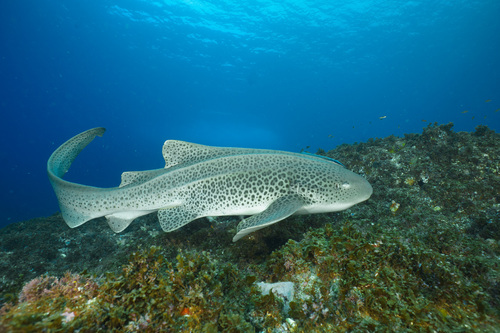
Zebra Shark
Stegostoma tigrinum
Often called the 'leopard shark' for its spotted adult coat, the Zebra Shark is a gentle, nocturnal reef-dweller with a tail as long as its body. This stunning carpet shark is a master of the seafloor, using powerful suction to hunt among the coral.
Quick Identification
Size
Grows up to 2.5 metres (8.2 feet) in length; weight typically ranges between 20–30 kg (44–66 lbs).
Colors
Adults are creamy-tan with numerous small dark brown spots; juveniles are dark brown with white vertical stripes and blotches.
Key Features
- Extremely long caudal fin nearly half the total body length
- Five prominent longitudinal ridges along the back and sides
- Blunt, rounded snout with small sensory barbels
When You’ll See Them
Geographic range
Where Does the Zebra Shark Live?
The zebra shark is a wide-ranging resident of the tropical Indo-Pacific region. It is natively found from the warm waters of South Africa and the Red Sea, stretching eastward across the Indian Ocean to the coastlines of India and Southeast Asia. Its range extends through the Indonesian archipelago to the northern coast of Australia and as far north as the southern islands of Japan.
Basemap © OpenStreetMap contributors
Behavior
Zebra sharks are primarily nocturnal, spending much of their daylight hours resting motionless on the sandy seafloor or near coral reefs. Unlike many other shark species, they are capable of 'buccal pumping,' which allows them to stay stationary and breathe by actively pumping water over their gills. This makes them a common sight for divers, as they often appear to be sleeping soundly on the bottom, propped up on their pectoral fins.
When the sun sets, these sharks become agile hunters. They use their flexible, slender bodies to squirm into narrow reef crevices and holes in search of food. Despite their impressive size as adults, they are remarkably docile and pose no threat to humans unless provoked. In fact, they are known to be quite social in certain environments, sometimes seen resting in loose groups during the day.
EverydayEarth exclusive
Camera Tips
To capture a zebra shark on an AI-powered camera, you will need a specialized underwater housing or a submersible trail camera setup. Position your camera on a weighted tripod on flat, sandy areas immediately adjacent to coral reef structures. Because these sharks are benthic dwellers, aim your lens horizontally across the seafloor at a height of approximately 30 to 50 centimeters (12 to 20 inches). This ensures you capture their full profile, including their signature long tail.
Using a scent-based attractant is the most effective way to draw a zebra shark into your camera's frame. A 'scent pot'—a perforated container filled with crushed shellfish, crabs, or oily fish—secured near the camera can pique their curiosity. Since they are suction feeders, they will often spend several minutes investigating a bait station, providing ample time for high-quality footage and AI identification.
Night settings are critical for this species. Ensure your camera is equipped with powerful infrared (IR) LEDs or a low-intensity, motion-activated underwater light. Zebra sharks are most active during the transition from dusk to night, so focus your monitoring during these hours. In the summer months, they often move into shallower reef flats for mating, which is the optimal season for high-frequency sightings in coastal 'backyard' reefs.
Similar Species
Species that look similar or are commonly confused with Zebra Shark.
Leopard Shark
Leopard sharks lack the long tail and body ridges of the zebra shark and are found primarily in the Eastern Pacific.
Tawny Nurse Shark
Tawny nurse sharks have a similar resting behavior but lack spots and have much shorter, differently shaped tail fins.
Whale Shark
While also spotted, Whale Sharks are massive filter feeders that stay in the open water column rather than resting on the seafloor.
Frequently Asked Questions
Record Zebra Shark at your habitat
Connect a camera to start building your own species record — AI identifies every visitor automatically.