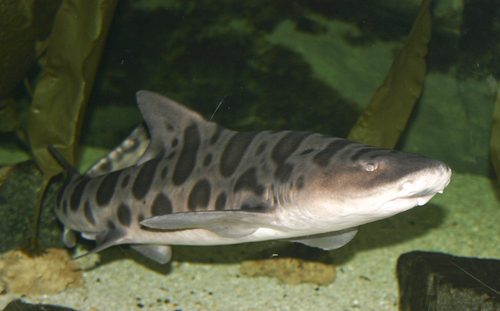
Leopard Shark
Triakis semifasciata
Admired for its stunning spotted coat and graceful movement, the Leopard Shark is a peaceful resident of North America's Pacific coastline. These social 'hounds of the sea' are a favorite for coastal observers, often seen gliding through sun-drenched kelp forests and shallow sandy bays.
Quick Identification
Size
Typically 1.2–1.5 m (3.9–4.9 ft) in length; weight ranges from 10–20 kg (22–44 lbs)
Colors
Silver or bronze-gray base with prominent black saddle-like bars and large oval spots; white underbelly
Key Features
- Distinctive black 'leopard' spots and saddle markings
- Slender, elongated body with a blunt, rounded snout
- Two large dorsal fins of similar size
- Large, cat-like oval eyes
When You’ll See Them
Sightings on EverydayEarth
Jun 29, 2026
A diverse array of marine life is active in this underwater lagoon. A Zebra Shark rests peacefully on the sandy bottom in the foreground near a coral structure, while another swims past. A Leopard Shark and several Bat Rays glide through the water in the background, navigating around the rockwork and artificial reef elements.
Jun 28, 2026
In the low light of the lagoon, a Zebra Shark is seen resting on the sandy bottom before beginning to swim, showing off its exceptionally long tail. A Bat Ray glides through the water on the right side of the frame, while several Leopard Sharks and other fish are active in the background and near the central rock formations.
Jun 28, 2026
A Zebra Shark is seen resting quietly on the sandy bottom in the foreground, displaying its distinctive spotted pattern. A large Bat Ray swims across the frame, passing very close to the camera lens with its rhythmic flapping motion. In the background, a Leopard Shark and several other fish are visible, either resting on the substrate or swimming through the lagoon environment.
Jun 28, 2026
In this underwater scene, a Blacktip Reef Shark swims through the upper water column. On the sandy bottom, a Leopard Shark rests quietly near a Green Sea Turtle, which is tucked under a central coral formation. A Bat Ray glides along the left edge of the frame, and several smaller fish swim throughout the lagoon.
Jun 28, 2026
A diverse array of marine life is active in the lagoon. A Blacktip Reef Shark swims prominently across the foreground from right to left. Below it, a Leopard Shark remains stationary on the sandy bottom near some artificial coral structures. Throughout the scene, a Bat Ray glides through the upper water column, and several smaller, unidentified fish dart around the background rocks.
Geographic range
Where Does the Leopard Shark Live?
The Leopard Shark is a classic inhabitant of the Eastern Pacific, found natively along the western coast of North America. Its core range begins in the temperate waters of Oregon and stretches southward through the entire California coastline, reaching deep into the Gulf of California and ending near Mazatlán, Mexico. This species is most commonly spotted in the shallow, protected estuaries and bays of Central and Southern California, where the warmer water and abundant food provide ideal conditions for both adults and juveniles.
Basemap © OpenStreetMap contributors
Behavior
Leopard Sharks are highly social and are frequently seen in large, nomadic schools that may include hundreds of individuals. These schools often consist of sharks of the same sex and size, and they sometimes associate with other species like the Gray Smooth-hound. Despite their intimidating name, they are exceptionally wary of humans and will typically flee at the first sign of a swimmer or diver, making them one of the safest shark species to encounter in the wild.
These sharks are strong, active swimmers that move with an undulating, eel-like motion. They are primarily bottom-dwellers, often found resting on or cruising just above sandy or muddy flats. Their activity levels are heavily influenced by the tides; as the tide rises, they move into shallow mudflats to forage, and as it recedes, they retreat into deeper channels or kelp forests.
EverydayEarth exclusive
Camera Tips
Capturing Leopard Sharks on camera requires a specialized approach compared to land mammals. For those with coastal or bay-front property, the most effective method is using a submerged action camera (like a GoPro) mounted to a weighted base or a pier piling. Position the camera about 30 to 60 centimeters (1-2 feet) above the seafloor, angled slightly downward to capture their bottom-hugging cruising behavior. Wide-angle settings are essential, as these sharks often swim very close to structures when navigating shallow channels.
Timing is critical when setting your camera triggers or timers. Leopard Sharks follow the tide; set your recordings to begin approximately two hours before high tide and continue for two hours after. This is when they are most likely to move into the shallows of bays and estuaries to forage. In clear water conditions, natural light is usually sufficient during the day, but at night or in murky estuaries, an external underwater red light can help illuminate the sharks without startling them or attracting excessive swarms of light-sensitive plankton.
Baiting is a controversial but effective method for attracting them to a specific camera site in areas where it is legal. A perforated PVC 'scent tube' filled with crushed crab or oily fish like mackerel can lure sharks into the camera's field of view. Ensure the tube is securely anchored to the bottom to prevent it from being carried away by the current. If you are filming from a pier or dock, a 'drop-down' camera rig lowered into a kelp forest edge can provide stunning footage of their social schooling behavior during the summer months.
Similar Species
Species that look similar or are commonly confused with Leopard Shark.
Frequently Asked Questions
Record Leopard Shark at your habitat
Connect a camera to start building your own species record — AI identifies every visitor automatically.