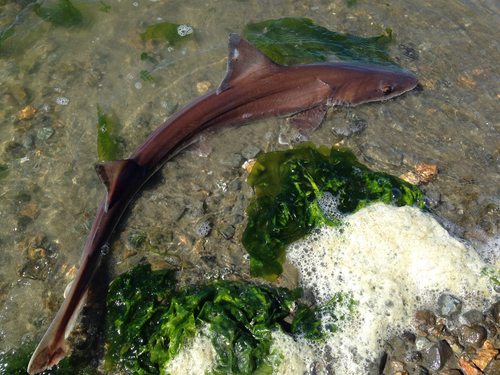
Brown Smooth-hound
Mustelus henlei
A bronze-tinted beauty of the Pacific coast, the Brown Smooth-hound is a graceful 'ground shark' that brings a touch of wild ocean mystery to suburban bays and estuaries.
Quick Identification
Size
50–100 cm (20–39 inches) in length; typically weighs 1.5–4 kg (3–9 lbs)
Colors
Bronze to reddish-brown on the upper body with a bright silvery-white belly
Key Features
- Slender body with a notably long, tapered snout
- Broad, triangular dorsal fins without spines
- Large, cat-like oval eyes
- Bronze or 'rusty' iridescent sheen on the back
When You’ll See Them
Geographic range
Where Does the Brown Smooth-hound Live?
Native to the eastern Pacific Ocean, the Brown Smooth-hound is a quintessential coastal resident of Western North America. Its core range spans from Northern California, including high densities in the San Francisco Bay, down through the Gulf of California. While most common in these temperate and subtropical waters, populations also extend along the coast of Central America into the southern hemisphere near Peru and Ecuador.
Basemap © OpenStreetMap contributors
Behavior
The Brown Smooth-hound is an active, bottom-dwelling shark known for its social nature, often traveling in schools sorted by size and sex. Unlike many larger shark species that must keep swimming to breathe, these sharks are frequently found cruising slowly over muddy or sandy bottoms, using their sensitive snouts to detect vibrations and chemical signals from hidden prey. They are generally skittish and pose no threat to humans, making them a favorite for catch-and-release anglers and marine observers.
These sharks exhibit a high degree of site fidelity, often returning to the same bays and estuaries year after year. They are viviparous, meaning they give birth to live young rather than laying eggs. During the late spring and summer, mature females move into shallower, warmer nursery areas to pup, which is often the best time for coastal residents to spot them in coastal shallows.
EverydayEarth exclusive
Camera Tips
Capturing a Brown Smooth-hound requires a specialized approach, as these are marine animals. If you have a backyard dock, pier, or a home overlooking a shallow bay, an underwater 'drop camera' or a waterproof trail camera in a protective housing is your best bet. Position the camera facing a flat, sandy, or muddy patch of the seafloor in 3 to 10 feet of water. Avoid areas with heavy kelp, as the swaying fronds will constantly trigger the motion sensor.
Baiting is the most effective way to bring these sharks into view. Secure a mesh 'chum bag' filled with crushed crabs or oily fish like mackerel about 2-3 feet in front of the lens. The Brown Smooth-hound has an exceptional sense of smell and will follow the scent trail directly to your camera. For the best results, use a camera with high-intensity infrared (IR) night vision, as these sharks are highly active during the 'golden hours' of dawn and dusk when light levels are low.
Since coastal waters can be murky, set your camera's focal range to 'near' if possible. Mounting the camera on a weighted PVC frame or a specialized underwater tripod will keep the footage stable against tidal currents. If you are using a camera that triggers on movement, increase the sensitivity to high, as the sleek movement of a shark can sometimes be too smooth to trigger lower-end sensors at a distance.
Similar Species
Species that look similar or are commonly confused with Brown Smooth-hound.
Leopard Shark
Features bold dark spots and saddles across a grey body, whereas the Smooth-hound is a uniform bronze color.
Gray Smooth-hound
Very similar in shape but lacks the reddish/bronze iridescence and typically has a more lead-gray coloration.
Spiny Dogfish
Easily distinguished by the sharp spines in front of both dorsal fins and white spots along its sides.
Frequently Asked Questions
Record Brown Smooth-hound at your habitat
Connect a camera to start building your own species record — AI identifies every visitor automatically.