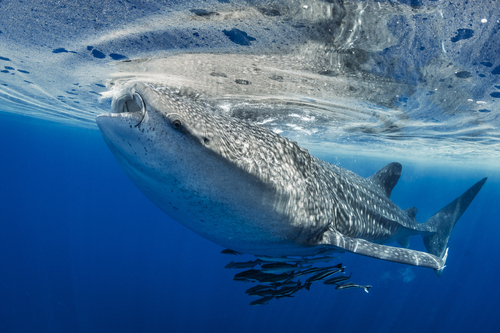
Whale Shark
Rhincodon typus
The Whale Shark is the ocean's largest fish, a docile filter-feeder that carries a galaxy of stars on its back. These prehistoric giants roam the world's tropical seas, connecting coral reefs and the deep blue through their epic migrations.
Quick Identification
Size
Typically 5.5–12 metres (18–39 feet) in length; can reach up to 18.8 metres (61.7 feet) and weigh over 20 metric tonnes (45,000 lbs).
Colors
Upper body is dark grey to blue-brown with a distinct 'checkerboard' pattern of white/creamy spots and vertical/horizontal stripes; underbelly is white.
Key Features
- Massive terminal mouth at the front of the head
- Unique white spot pattern behind the gills (individual fingerprints)
- Three prominent longitudinal ridges along the upper flanks
- Broad, flattened head with small eyes
When You’ll See Them
Geographic range
Where Does the Whale Shark Live?
The majestic Whale Shark is a true globetrotter of the deep, inhabiting all tropical and warm-temperate seas across the planet with the exception of the Mediterranean. These gentle giants are most frequently encountered in the nutrient-rich waters of the Indo-Pacific, with significant populations found near the coasts of Australia, the Philippines, and Indonesia. In the Western Atlantic, they are a seasonal highlight in the Gulf of Mexico and the Caribbean, often drawn to the coastlines of Mexico and Belize by massive plankton blooms.
Basemap © OpenStreetMap contributors
Behavior
Whale Sharks are the gentle giants of the ocean, moving through the water with a slow, rhythmic side-to-side tail beat. Unlike many other sharks, they are filter feeders that primarily consume microscopic prey. They exhibit two main feeding methods: 'ram filtration,' where they swim forward with mouths agape to scoop up food, and 'suction feeding,' where they remain stationary and gulp in large volumes of water to strain out nutrients.
These sharks are generally solitary and highly migratory, traveling thousands of miles between feeding grounds. However, they are known to congregate in massive numbers—sometimes in the hundreds—at specific 'hotspots' during seasonal events like coral spawning or fish egg blooms. They are remarkably docile and curious around humans, often allowing snorkelers and divers to swim alongside them without showing signs of aggression or fear.
EverydayEarth exclusive
Camera Tips
Capturing the world's largest fish requires specialized underwater equipment, as a standard land-based trail camera will not survive the salt and pressure. If you live on a coastal property or frequent a reef edge, a high-quality action camera with a dedicated dive housing is essential. To get the most scientifically valuable footage, try to capture the 'identification zone'—the area of spots directly behind the shark's gills on its left side. These patterns are unique to every individual, much like a human fingerprint.
Lighting is your biggest challenge in an underwater 'backyard' setting. In shallow coastal waters where Whale Sharks often feed near the surface, natural sunlight is usually sufficient between 10 AM and 2 PM when the sun is directly overhead. If you are setting a stationary underwater rig on a pier or reef, ensure the lens is treated with a hydrophobic coating to prevent bubbles and debris from obscuring the shot. High frame rates (at least 60fps) are recommended to capture the massive, slow movements of the shark's tail and the opening of its cavernous mouth.
While you cannot use traditional bait in a marine environment without disturbing the ecosystem, Whale Sharks are naturally attracted to specific biological events. Timing your camera placement with local coral spawning or fish egg blooms will significantly increase your chances of a sighting. If using a motion-triggered underwater housing, ensure the sensitivity is adjusted for large objects moving at a distance; otherwise, small passing fish may deplete your battery before the giant arrives.
Similar Species
Species that look similar or are commonly confused with Whale Shark.
Frequently Asked Questions
Record Whale Shark at your habitat
Connect a camera to start building your own species record — AI identifies every visitor automatically.