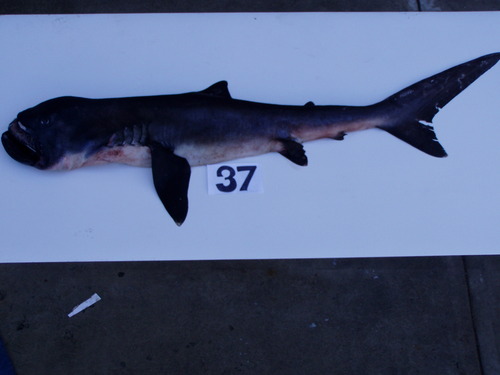
Megamouth Shark
Megachasma pelagios
A gentle giant of the deep, the Megamouth Shark is a prehistoric-looking filter feeder that was only discovered by humans in 1976. With its massive head and glowing mouth, it remains one of the ocean's most captivating mysteries.
Quick Identification
Size
4 to 5.5 metres (13 to 18 feet) long; weight up to 1,215 kg (2,679 lbs)
Colors
Brownish-black to grayish on the dorsal side with a starkly contrasting creamy white or silvery-white belly and white tips on the fins
Key Features
- Massive bulbous head with a wide, terminal mouth
- Distinctive silvery-white 'luminous' band along the upper jaw
- Soft, flabby body with small, rounded dorsal fins
When You’ll See Them
Geographic range
Where Does the Megamouth Shark Live?
Where Does the Megamouth Shark Live? This mysterious giant is a nomadic resident of the world's deep oceans, found primarily in the tropical and temperate waters of the Atlantic, Indian, and Pacific Oceans. While it is a global species, the majority of sightings have clustered in the Western Pacific, particularly around the coastal waters of Japan, Taiwan, and the Philippines. In the Western Hemisphere, they have been documented near the coastlines of California and Mexico, as well as Brazil and South Africa, suggesting a range that spans the entire globe between 40°N and 40°S latitude.
Basemap © OpenStreetMap contributors
Behavior
The Megamouth Shark is one of the most elusive marine species on the planet, known for its extreme vertical migrations. During the day, it retreats to the dark, cold mesopelagic zone, roughly 120 to 160 metres deep. As night falls, it ascends into the shallower epipelagic zone to follow the movement of plankton, staying around 12 to 25 metres from the surface. This 'diel vertical migration' allows it to remain in the shadows while staying close to its food source.
Unlike many sharks that must swim constantly to breathe, the Megamouth is a relatively slow, sluggish swimmer. It is a filter feeder, cruising through the water with its massive mouth wide open to engulf clouds of tiny organisms. Despite its intimidating size and name, it is entirely harmless to humans and has rarely been seen alive in its natural habitat; most of what we know comes from a few hundred recorded sightings and accidental catches since its discovery in 1976.
EverydayEarth exclusive
Camera Tips
Capturing a Megamouth Shark on camera is the 'Holy Grail' for marine wildlife enthusiasts and requires specialized equipment. Unlike backyard wildlife, these sharks live in the deep ocean, so you will need a high-end ROV (Remotely Operated Vehicle) or a deep-sea drop camera. Because they are most active near the surface at night, your best chance for a 'shallow' capture is between sunset and sunrise in known transit corridors like the waters off Southern California or the Philippines.
Lighting is your biggest challenge. Megamouth Sharks are thought to have a reflective or bioluminescent band inside their mouths to lure prey. To capture this without washing out the shark's features, use soft, wide-angle LED arrays rather than a single harsh spotlight. Set your camera to a high ISO and a fast shutter speed to account for the movement of the ROV and the swaying of the ocean currents.
If you are using a stationary baited camera rig, target depths between 150 and 500 metres during the day. While they aren't attracted to traditional meat bait like Great Whites, 'light lures' that mimic bioluminescent plankton may piquing their curiosity. Ensure your housing is pressure-rated for at least 1,000 metres and use a wide-angle lens to capture the shark's full profile, as they can exceed 15 feet in length.
Similar Species
Species that look similar or are commonly confused with Megamouth Shark.
Whale Shark
Much larger with a distinctive white-spotted pattern and flatter head.
Basking Shark
Features a more pointed snout and a massive mouth that opens much wider for surface feeding.
Greenland Shark
Has a much smaller mouth and is found in Arctic waters, lacking the Megamouth's bulbous head shape.
Frequently Asked Questions
Record Megamouth Shark at your habitat
Connect a camera to start building your own species record — AI identifies every visitor automatically.