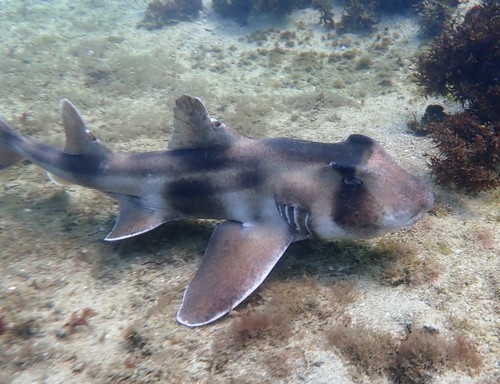
Crested Hornshark
Heterodontus galeatus
With its dramatic 'eyebrows' and ancient lineage, the Crested Hornshark is one of Australia's most charismatic reef residents. This slow-moving beauty offers a glimpse into a prehistoric world right beneath the ocean's surface.
Quick Identification
Size
Typically reaches a length of 1.2 metres (3.9 feet); newborns are roughly 17–22 cm (7–9 inches).
Colors
Brownish to tan base color with large, dark, irregular transverse blotches and smaller spots; features distinctive dark 'eyebrow' ridges above the eyes.
Key Features
- Prominent high ridges above the eyes (crests)
- Two high dorsal fins, each with a sharp leading spine
- Broad, blunt head with a pig-like snout
- Small, dark spots interspersed among large, dark saddle-like bands
When You’ll See Them
Geographic range
Where Does the Crested Hornshark Live?
Native to the coastal waters of the southwestern Pacific, the Crested Hornshark is an Australian endemic. It is primarily found along the eastern coastline of the continent, ranging from central Queensland down through New South Wales. While it is most concentrated in warm temperate and subtropical reef systems, its presence is highly localized to these specific rocky marine corridors.
Basemap © OpenStreetMap contributors
Behavior
The Crested Hornshark is a sluggish, bottom-dwelling species that spends much of its day resting in rocky crevices or hidden among thick kelp forests. Primarily nocturnal, it emerges at night to forage along the seafloor, using its specialized mouth to crush hard-shelled prey. Despite their somewhat formidable appearance and dorsal spines, they are generally docile and non-aggressive toward humans, though they should be treated with respect as their spines can cause injury if handled.
Socially, these sharks are mostly solitary, though they may congregate in favorable feeding or mating grounds. They are oviparous, meaning they lay eggs; their egg cases are distinctive dark spirals with long tendrils that the female wedges into crevices or wraps around seaweed to prevent them from drifting away. This species is highly site-attached, often returning to the same resting spots day after day.
EverydayEarth exclusive
Camera Tips
Capturing a Crested Hornshark on camera requires an underwater setup, such as a GoPro or a specialized trail camera in a waterproof housing rated for at least 10 metres. For those with 'backyard' ocean access, such as private jetties or rocky shorelines, mount your camera at a slight downward angle facing a sandy patch adjacent to a rocky ledge. These 'edge' zones are the shark's primary hunting corridors where they search for urchins.
Since they are strictly nocturnal, artificial lighting is essential. Use a wide-angle video light with a warm temperature to avoid 'blowing out' the shark's pale underside. If your camera has a motion trigger, ensure it is set to high sensitivity, as these sharks move slowly and gracefully, which can sometimes fail to trigger less sensitive sensors. Setting the camera to record short video clips rather than still photos will better capture their unique 'walking' motion across the seabed using their pectoral fins.
If you are placing a camera near a pier or in a tide pool, bait can be an effective lure. A perforated PVC pipe filled with oily fish like sardines or mackerel (the 'chum' method) will draw them in from their crevices. However, always check local marine park regulations before using bait. In the winter months, look for their spiral egg cases; placing a camera near a freshly laid egg case may capture the female returning or other reef life interacting with the site.
Similar Species
Species that look similar or are commonly confused with Crested Hornshark.
Frequently Asked Questions
Record Crested Hornshark at your habitat
Connect a camera to start building your own species record — AI identifies every visitor automatically.