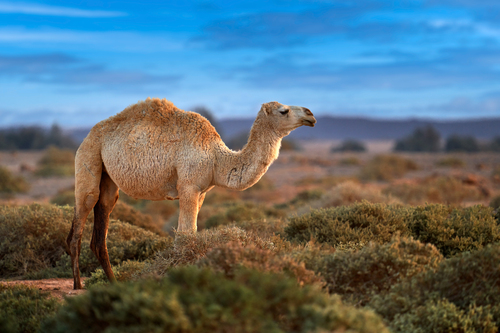
Dromedary Camel
Camelus dromedarius
The ultimate desert survivor, the Dromedary Camel is a marvel of biological engineering. Whether roaming the dunes of the Sahara or the vast Australian bush, these one-humped giants are a majestic sight to capture on camera.
Quick Identification
Size
Males stand 1.8–2.4m (5.9–7.9ft) at the shoulder and weigh 400–690kg (880–1,520lb); females stand 1.7–1.9m (5.6–6.2ft) and weigh 300–540kg (660–1,190lb).
Colors
Typically shades of caramel, beige, or dark brown; some individuals appear cream-colored or nearly black. Hairs are longer on the throat, hump, and shoulders.
Key Features
- Single prominent hump on the back
- Long, curved neck and narrow chest
- Large, padded feet with two toes for walking on sand
- Double row of extra-long eyelashes and slit-like nostrils
When You’ll See Them
Sightings on EverydayEarth
Jun 29, 2026
A large herd of dromedary camels is seen migrating through a woodland clearing. They walk steadily from right to left across the dry, grassy terrain under bright daylight.
Geographic range
Where Does the Dromedary Camel Live?
The Dromedary Camel is native to the scorching deserts of the Arabian Peninsula and across North Africa, stretching through the Middle East into parts of India and Pakistan. While their ancestral wild forms are extinct, they have been successfully introduced to the Australian Outback, where a massive feral population now roams the arid interior. In these regions, they are frequently seen near pastoral stations, ephemeral riverbeds, and vast sandy dunes.
Basemap © OpenStreetMap contributors
Behavior
Dromedary Camels are highly social animals that typically congregate in herds led by a dominant male. They are diurnal, meaning they are most active during the daylight hours, though they may rest during the absolute peak of midday heat to conserve energy and moisture. Their movement is characterized by a 'pacing' gait, where both legs on one side move together, creating a swaying motion that has earned them the nickname 'Ships of the Desert.'
In their interactions with humans, Dromedaries are generally docile and have been domesticated for over 3,000 years, though feral populations—particularly in Australia—can be more wary and unpredictable. They communicate through a variety of vocalizations including deep bellows, groans, and bleats, and use body language such as head-bobbing and tail-flicking to signal their intentions to the herd.
EverydayEarth exclusive
Camera Tips
Because Dromedaries are exceptionally tall animals, camera placement is the most critical factor for a good shot. Mount your camera at least 5 to 6 feet (1.5–1.8 meters) high on a sturdy post or tree, angled slightly downward. This prevents the camera from simply capturing their legs or underbelly and allows for a full-body view that includes their iconic hump and head. Use a wide-angle lens setting if your camera supports it, as these giants can fill a frame very quickly.
In arid environments, the best way to attract Dromedaries to your camera site is by focusing on resources. If you are on a private ranch or station, placing a camera near a water trough or a known salt lick is almost a guarantee for activity. They have a keen sense of smell and can detect moisture from miles away. During the dry season, these watering holes become the social hubs of the desert, providing opportunities to capture entire herds and young calves.
Dromedaries are relatively slow-moving, so you don't necessarily need the fastest trigger speed, but you should set your camera to take a multi-shot burst or 'Photo + Video' mode. Their social interactions—such as neck-wrestling among males or the way mothers nuzzle their calves—are best captured in short 20-30 second video clips. Be mindful of the sun; in open desert environments, harsh glare can wash out your images. North-facing placements are generally best to keep the sun behind the camera during the most active morning and afternoon periods.
Lastly, ensure your camera housing is rugged and securely fastened. Dromedaries are notoriously curious and may use a camera-mounted post as a scratching post. A heavy-duty security box or a well-camouflaged strap system is essential to prevent your gear from being knocked over or damaged by several hundred kilograms of camel leaning against it.
Similar Species
Species that look similar or are commonly confused with Dromedary Camel.
Frequently Asked Questions
Record Dromedary Camel at your habitat
Connect a camera to start building your own species record — AI identifies every visitor automatically.