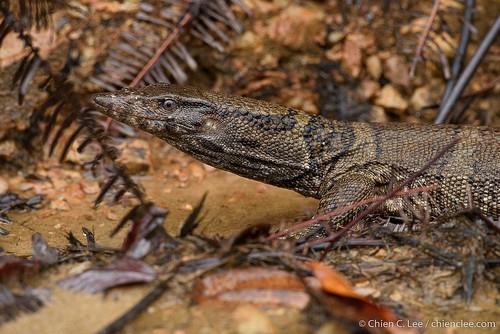
Dumeril's Monitor
Varanus dumerilii
The Dumeril's Monitor is the 'ghost of the mangroves,' a master of camouflage with a specialized taste for crabs and a remarkable ability to vanish into the canopy.
Quick Identification
Size
Total length of 100-135 cm (3.3-4.4 ft); weight typically ranges from 1.5-3 kg (3.3-6.6 lbs).
Colors
Adults are dark chocolate brown to grayish-black with faint tan cross-bands; juveniles are strikingly different with bright orange or red heads and black bodies.
Key Features
- Enlarged, plate-like scales on the back of the neck
- Slender, elongated snout with nostrils set back toward the eyes
- Dull brown or blackish adult coloration providing excellent camouflage
When You’ll See Them
Geographic range
Where Does the Dumeril's Monitor Live?
Where Does the Dumeril's Monitor Live? This species is a native of the humid tropical regions of Southeast Asia. Its core range is centered in Thailand, Malaysia, and the Indonesian islands of Sumatra and Borneo, extending into parts of Myanmar and Singapore. It is a lowland specialist, almost exclusively found in wet, forested environments where it can easily transition between terrestrial and aquatic hunting grounds.
Basemap © OpenStreetMap contributors
Behavior
The Dumeril's Monitor is a notably shy and secretive lizard compared to its more famous relative, the Asian Water Monitor. It is a semi-aquatic specialist that spends a significant portion of its life in or near water, but it is also a highly skilled climber. When threatened, this species typically retreats into the water and can remain submerged for extended periods, or it may scramble up the nearest tree to hide in the canopy.
In terms of social interaction, these monitors are primarily solitary. They are not known to be territorial in the aggressive sense that some larger monitors are, often preferring avoidance over confrontation. For people living near their habitat, they are elusive neighbors that provide excellent pest control by feeding on crustaceans and large insects, though they are rarely seen in open suburban environments unless there is significant tree cover and a water source.
EverydayEarth exclusive
Camera Tips
To successfully capture a Dumeril's Monitor on your trail camera, you need to focus on the 'edge' zones of their habitat. Look for fallen logs that bridge small streams or muddy banks where crab burrows are visible. Position your camera about 2 feet off the ground, angled downward toward these transit points. Because they are cold-blooded, they often spend mid-mornings basking on logs that receive direct sunlight; these are prime spots for high-quality daytime triggers.
Since these monitors are attracted to scent, you can increase your chances by using a non-consumable lure. A small container of fish oil or crushed crab shells secured near the camera's field of view can entice them to linger. Unlike more curious mammals, monitors may move past very quickly once they realize there isn't a meal, so setting your camera to 'Video Mode' with a 15-20 second duration is far superior to still photos for observing their slow, deliberate tongue-flicking behavior.
Standard PIR (Passive Infrared) sensors can sometimes struggle with reptiles if their body temperature matches the ambient tropical air. To counter this, use a camera with high sensitivity settings and place it in a spot where the lizard's body will be silhouetted against a cooler background, like water or deep shade. If you are using a backyard camera near a forest edge, ensure the area is quiet; these monitors are extremely sensitive to vibrations and human noise.
Lastly, consider the humidity. In the native range of the Dumeril's Monitor, moisture can easily fog lenses or corrode electronics. Use desiccant packets inside your camera housing and ensure the seals are tight. Checking your camera after a heavy rain can be rewarding, as these lizards often become more active when the ground is wet and their crustacean prey is on the move.
Similar Species
Species that look similar or are commonly confused with Dumeril's Monitor.
Frequently Asked Questions
Record Dumeril's Monitor at your habitat
Connect a camera to start building your own species record — AI identifies every visitor automatically.