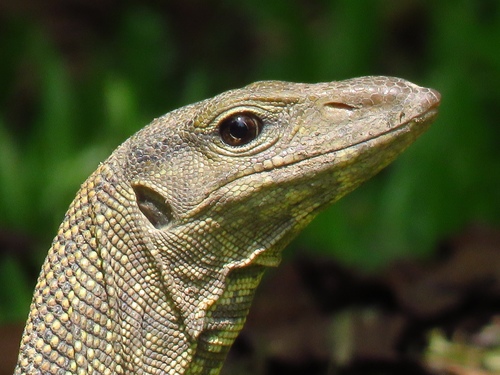
Clouded Monitor
Varanus nebulosus
The Clouded Monitor is the arboreal acrobat of the lizard world, blending perfectly into the dappled light of Southeast Asian forests. A master of both earth and sky, this intelligent scavenger is a fascinating visitor to any tropical backyard.
Quick Identification
Size
Total length typically 1 to 1.5 meters (3.3 to 5 feet); weight ranges from 1 to 5 kg (2.2 to 11 lbs).
Colors
Greyish-brown to olive base with numerous light yellow spots or ocelli; dark temporal stripes extend from the eyes down the neck.
Key Features
- Light yellow spots creating a 'cloudy' appearance
- Nostrils located midway between the eye and the snout tip
- Strong, curved claws optimized for tree climbing
- Long, powerful tail used for balance and defense
When You’ll See Them
Geographic range
Where Does the Clouded Monitor Live?
Native to the tropical heart of Southeast Asia, the Clouded Monitor thrives across a wide geographic footprint. This resilient lizard is found throughout Myanmar, Thailand, Laos, and Vietnam, extending southward into Peninsular Malaysia and Singapore. It is also a common sight on the Indonesian islands of Sumatra and Java, where it occupies both dense jungle and the fringes of human settlements.
Basemap © OpenStreetMap contributors
Behavior
The Clouded Monitor is a highly active, diurnal reptile that splits its time between the forest floor and the canopy. Unlike its cousin, the Asian Water Monitor, this species is a master climber, often seen scaling vertical trunks with surprising speed to bask in the sun or escape predators. They are generally solitary and wary of humans, though they can become accustomed to presence in quiet suburban gardens.
These lizards are intelligent foragers, using their long, forked tongues to 'taste' the air and track down prey or carrion. When threatened, they may hiss loudly, inflate their necks to appear larger, or lash out with their whip-like tails. Despite their formidable appearance, they are non-aggressive toward humans and prefer to retreat into thick brush or up a tree at the first sign of trouble.
EverydayEarth exclusive
Camera Tips
To capture a Clouded Monitor on camera, focus on transition zones. Place your camera near the base of large, leaning trees or along stone walls where they like to bask and hunt. Since they are diurnal, ensure your camera's motion sensor is optimized for daytime triggers. Mounting the camera about 12-18 inches off the ground, angled slightly upward, will provide the best view of their specialized climbing posture.
Scent is the best way to draw these monitors into frame. A small amount of pungent bait, such as an open tin of sardines or a cracked egg placed inside a perforated container, will lure them in. Because they are cautious, place the lure in a spot that offers some overhead cover; they are more likely to linger if they feel protected from aerial predators like eagles.
Use a fast shutter speed if your camera allows it, as their flicking tongues and quick movements can cause motion blur. If you are monitoring a specific tree trunk where you have seen them climbing, a vertical mounting position on an adjacent tree can capture spectacular 'action shots' of them scaling the bark.
Similar Species
Species that look similar or are commonly confused with Clouded Monitor.
Frequently Asked Questions
Record Clouded Monitor at your habitat
Connect a camera to start building your own species record — AI identifies every visitor automatically.